
JournalArt10 min

Today the Impressionists look almost like a guarantee of a pleasant evening at a museum. Light, water, gardens, city cafés — it is hard to imagine that this language was once considered crude, unfinished and even laughable. But the first viewers saw not a cosy classic but a breach of professional order.
Academic painting1 valued large subjects, clear drawing and a surface on which the work of the brush did not catch the eye. The Impressionists brought contemporary life, changing light and a stroke that did not conceal the process. A picture could look as though the painter had stopped earlier than he should.

The name itself was born out of mockery of Monet’s “Impression, Sunrise”. A critic used the word “impression” to underline the incompleteness, and the group adopted it as the label for a shared search.
Nobody knew how the argument would end
The success of Impressionism created a strange optical illusion. It now seems as though the movement was heading straight for a museum victory: the painters went out to paint air, the public grumbled a little and then acknowledged the obvious. In reality nobody knew how the argument would end. The independent exhibitions were a way of surviving without the Salon’s2 approval, not a rehearsal for a future triumph. The participants disagreed, quarrelled, missed exhibitions and gradually went their separate ways. What they shared was a distrust of the old system rather than a single programme for decades ahead.
Even the famous work in the open air was not a simple worship of the moment. A small study can be made quickly by a river, but a large picture often went on being assembled in the studio. The painter chose, simplified, repeated the motif, changed the relations between patches. “Impression” did not mean the absence of construction. The novelty was that the construction stopped hiding the sensation of a particular light and a particular second. The viewer saw not an eternal object but the meeting of an object with the weather.
Technical changes helped that meeting. Paint in tubes, new pigments, portable equipment, the railway and an expanded city made other routes and another tempo available. But technology did not create the movement automatically. Thousands of people could travel to the suburbs; only a few saw in the trembling reflection of water a subject worthy of large painting. A tool becomes an artistic event when it changes not only the convenience of work but the idea of what deserves attention at all.

They did not work alike and did not constitute an orderly school. But they were united by an attention to how a view changes at a specific moment. The colour of an object stopped counting as a permanent property: snow could be blue, a shadow coloured, a façade different every hour.
It was not only painting that won, but another system of showing
The success of Impressionism changed the market as well. The independent exhibitions showed that painters could address the public bypassing the official Salon, and dealers such as Durand-Ruel3 helped to create an international audience. The new painting won not only aesthetically — another system of display and sale arose around it. That is an important part of any revolution: it is not enough to invent a language, you also have to find a place where it will be seen without an old jury that has decided in advance that such work is a mistake.
New paint in tubes and the railway also took part in the revolution. It became easier for a painter to leave the studio, travel to the suburbs, paint quickly in the open air. Technology, city life and an artistic idea met at one point.

“Unfinishedness” was a breach of the norm
The word “unfinished” in the criticism of the Impressionists was not simply an insult. It pointed to a breach of a professional norm. An academic surface was supposed to conceal the labour: the viewer saw a convincing world, not the separate decisions of a brush. The Impressionists left the process in view. The stroke stopped being scaffolding to be removed before the building opens and became part of the experience. From a distance the patches gathered into light; close up they fell apart into paint. The viewer’s own sight was enlisted to complete the work.
That participation later became habitual. We have learned to assemble Monet’s strokes into water and air automatically, so the former coarseness seems gentle. Cultural habit works invisibly: what one era perceived as a lack of finish, another sees as an agreeable texture. That is worth remembering when a contemporary work looks “inept” at first glance. Sometimes what we have in front of us really is weakness, sometimes a language for which the skill of reading does not yet exist. What helps to tell them apart is not shock but the consistency of the decisions.
The series: change becomes the subject
Monet’s series show where an interest in instantaneous light could lead. One cathedral, haystack or pond stops being the sole subject; the subject becomes change. The repetition is needed not because the author has nothing else to paint but in order to separate the stable form from what the light, the air and the observer’s own state do to it each time. For a photographer this is especially clear. To photograph one façade at different hours is to see that “the colour of the building” exists in a catalogue rather than in experience.

Renoir, Degas, Pissarro, Monet and Morisot had different interests, so a convenient common label quickly becomes tight. Degas disliked being thought of as a plein-air painter; he was occupied with composition, artificial light, movement and unexpected cropping. Morisot saw modern life from a position that did not coincide with the male experience of boulevards and cafés. The shared revolution consisted of different degrees of access to the city, the body and private life. The closer we look, the less the movement resembles a friendly team in matching berets.
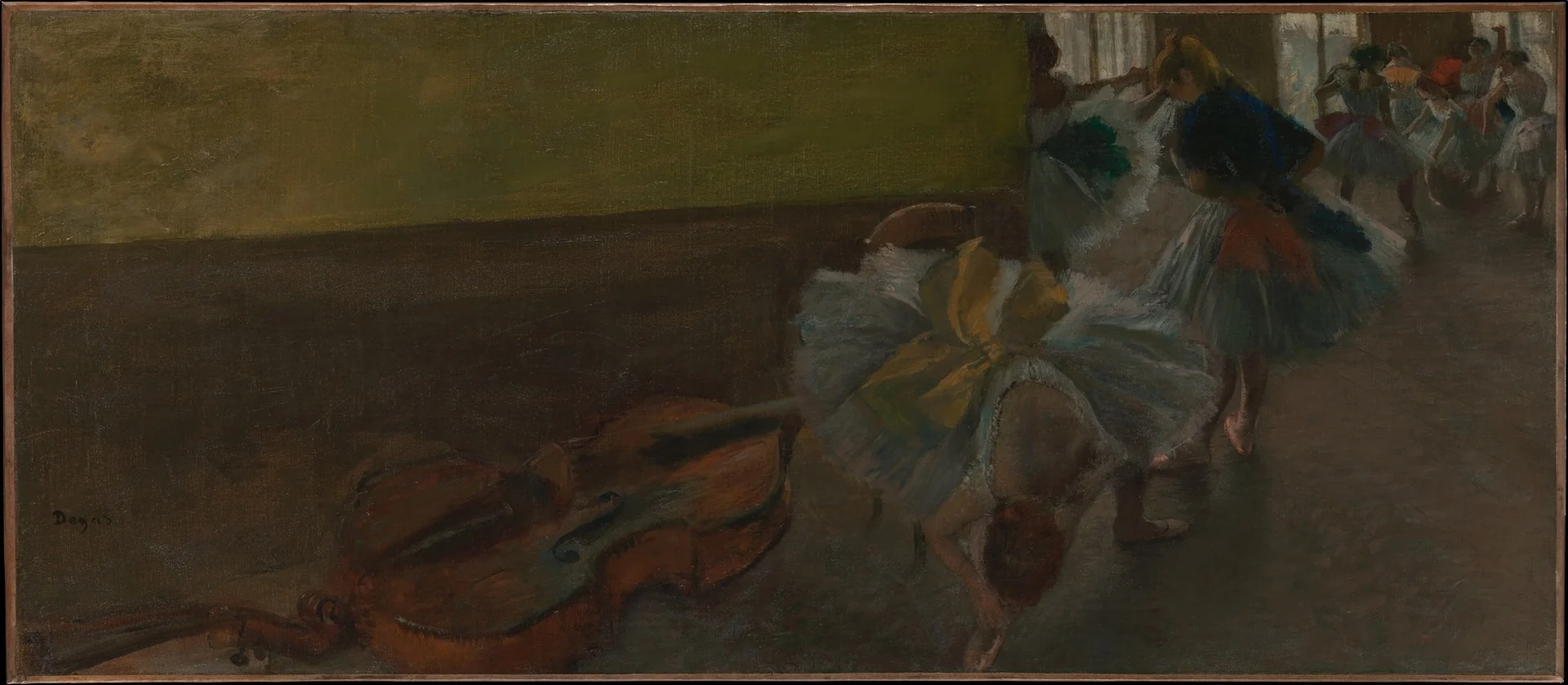
Reproductions of the Impressionists are worth examining at different distances. Close up you see separate strokes and patches of colour; from a distance they gather into air and light. The picture does not merely depict an optical impression but partly produces it inside the viewer’s own sight.

How did it all end? The public got used to it, the market accepted the new language, and the painters moved further apart. One looked for structure, another for colour, another for symbolic content. Out of Impressionism grew a multitude of movements that were already arguing with it.
Any artistic revolution risks becoming a postcard. When a device no longer breaks expectations, it turns into a familiar beauty. That does not cancel the original discovery. The Impressionists gave a painter the right to consider an instantaneous visual impression worthy of a large picture.
The discovery created new questions
Impressionism also ended because its own discovery created new questions. If colour depends on light, can it be made independent of the observed motif? If the stroke is visible, must it describe an object or can it live by a construction of its own? If a moment deserves a painting, how is stability to be returned to form? Cézanne looked for structure, Seurat for a system of colour interaction, Van Gogh for the emotional force of line and hue, Gauguin for a symbolic world. They did not cancel the Impressionists; they carried the argument on where the language already found no longer answered.

The market played no smaller a part than theory. A dealer, a buyer and an independent exhibition created a route by which the new painting could reach the public. This is not a grubby appendix to pure art. Until a work has a place to be shown, a critic sees it only as a violation of the official venue’s rules. An alternative system makes it possible to assemble another norm. A present-day author recognises the situation in small galleries, photobooks, online series and self-organised shows: the form of distribution can be part of the artistic discovery.

Any language risks becoming a filter
But the market’s victory can tame the risk. Once dappled sunlight became the favourite ornament of calendars, the technique detached itself from the original courage. We got an endless supply of the “impressionistic”: soft, agreeable, deprived of any question about the present. Any innovative language eventually risks becoming a filter. That is not the fault of the discoverers but the usual fate of a successful solution. The more easily a device is recognised, the less it guarantees living observation.
Photography has travelled the same road many times. High contrast, film grain, direct flash, deliberate blur first break the idea of a correct image, then enter the visual vocabulary and finally become a button in an app. At every stage the meaning changes. Blur that arose from an attempt to convey speed and blur added because it is now the done thing can look alike, but the viewer feels the difference in the rest of the construction. A device lives as long as it is connected to a reason.
Impressionism depends on the viewer’s body
It also helps to change your distance. Up close the picture speaks through material: the stroke, the thickness, the neighbouring pigments. A few steps back and air appears. In a reproduction that physical montage is often lost, because the screen has chosen the scale in advance. Impressionism depends particularly on the viewer’s body: you have to come close, see the disintegration, step back and let the eye assemble the whole. The picture turns out to be not a window with a fixed viewpoint but an instrument for testing your sight.
The end of the movement therefore cannot be reduced to the date of the last exhibition. It ended as a shared practical necessity and continued as a condition of the art that followed. After the Impressionists it was already hard to regard colour as the constant tint of an object and a visible stroke as nothing but a sign of incompleteness. Those rights became so ordinary that we stopped noticing where they came from.
There is a paradox in any successful revolution. First it makes the viewer learn, then it becomes their habit, and then it demands a new breach for the eye to wake up again. Impressionism did not die when the painters went their separate ways. It dissolved into a common way of seeing — and that is exactly why it stopped being a sufficient answer for the next generation.
Their story is a reminder: a viewer often calls inability what they simply have no habit for. And then the new habit becomes so natural that the former scandal is hard to believe in.
Notes
- 1The system built around the Académie des Beaux-Arts: a hierarchy of genres in which the history painting stood above landscape and the everyday scene, obligatory drawing as the foundation, a smooth surface and a subject you could retell. It was taught over years, and a breach read not as a choice but as incompetence. ↑
- 2The annual official exhibition in Paris, through which nearly all commissions and all reputation passed. A jury’s rejection meant there was simply nowhere to show the work: galleries of contemporary art in the present sense did not yet exist. ↑
- 3Paul Durand-Ruel — the dealer who bought the Impressionists for decades, kept them alive on advances, went bankrupt over it and in 1886 took a large exhibition to New York. The American market accepted the new painting before the French one did, and recognition came from there. ↑