
JournalPhotography9 min

Photography has no single tidy birthday. Long before light-sensitive materials people knew how to obtain a projection of the world with a camera obscura1: light passed through a small aperture and drew an inverted image. The problem was that the drawing vanished along with the light.

The next step took centuries: a surface had to be found that would not merely react to light but preserve its action. In the nineteenth century the experiments of Niépce, Daguerre, Talbot2 and other inventors produced different ways of fixing an image. They argued not only about chemistry but about the future of the new medium: would every picture be unique, or could it be multiplied?
Looking at early photography is useful for another reason too: many of its visual habits are still alive — the frontal pose, the stillness, the trust in a print as testimony. The technology has changed radically, and a viewer’s memory still recognises those old forms and credits them with a certain truthfulness.
Light could draw before photography
Before photography people had long known that light can draw. In a dark room with a small aperture the outside world appears inverted on the wall: clouds move, people pass, trees sway. The optics of a camera are already there in that spectacle, but there is no picture yet. The image exists only now and disappears as soon as the light changes. The main revolution happened not when people learned to obtain a projection but when the light they found could be turned into a trace.
Preservation changed the nature of the image at once. A drawing implies the movement of a hand; a photograph promises a physical connection with what stood in front of the lens. That promise became the source of a particular trust. Even understanding the author’s role, we go on feeling that the thing must have been there, otherwise the light would not have left its trace. The digital era has complicated that connection, but the emotional habit has not gone anywhere — a family snapshot is still experienced differently from an accurate illustration of the same scene.
The early processes offered not one straight road to the modern camera but different models of the future. A unique image astonished with its detail and the value of a singular object. The negative-positive principle3 opened the possibility of multiplication. Behind the chemical differences lay a cultural question: would photography be a rare thing, almost a relic, or a circulating message? In the end it became both — a museum print and a picture disappearing into a stream.

Long exposures edited the world
A long exposure did not merely inconvenience the first photographers. It edited the world. Everything motionless earned the right to remain, everything moving became faint or vanished. Hence the famous emptiness of early city views: architecture survived the exposure time better than people. The technology created a philosophy with no intention on the author’s part — the city looked eternal and life in it spectral.

The first exposures lasted a long time. A street could look empty not because nobody was on it but because moving people had no time to register. A portrait required stillness, and sometimes the head was supported by a special stand. A technical limitation quietly created a visual language of serious, frozen faces.
Painting did not disappear with the arrival of photography, although the fears were serious. The new medium took away part of the applied work — above all exact portrait likeness — but at the same time made painters think differently about colour, time and visible reality. And photographers, trying to prove their art was art, at first actively borrowed painterly poses and soft treatment. The history of the two media does not resemble one replacing the other. It is a long exchange that continues in every conversation about composition and an author’s eye.
When exposures grew shorter, photography began to catch gesture and chance. When cameras became more available, the image stopped belonging only to studios and institutions. It entered family memory, the press, science, the police, advertising and art.
The seriousness of old portraits is technical time
A portrait too was a contract with a limitation. To sit motionless for a long while means to compose a face, to hold a body, not to let a chance expression destroy the image. The seriousness of old portraits has to do with more than the manners of the age. A smile is harder than a motionless expression, and the procedure itself was an event requiring concentration. Technical time became a social gesture that we now mistakenly read as the character of everyone in the past.

When exposures shortened, another body entered photography: walking, laughing, making mistakes. The snapshot made chance an aesthetic value. A sense arose that the camera snatches the truth before a person has time to play a role. But that truthfulness is conventional too. The author chooses which fraction of a second to declare revealing, and the viewer easily attributes a settled character to a single expression.

The exchange with painting has not ended
The argument between photography and painting is often retold as the victory of a new technology over an old profession. In fact the media began to irritate and to liberate each other. Painting no longer had to serve likeness single-handed; photography, proving its artistry, borrowed the compositions, gestures and softness of the painted image. Later photographic chance changed painters’ view of cropping and movement. That connection continues: a digital portrait may imitate film, and a painter may use photographic cropping without a thought about where the habit came from.
History also reminds us of the materiality of a picture. Glass, metal, paper, a chemical layer, a box of family archives — an image always had a body, aged, got scratched, passed from hand to hand. A screen creates an impression of bodilessness, but a digital file also depends on devices, formats and storage. We produce more photographs than ever and are not sure which of them will survive the next change of phone.
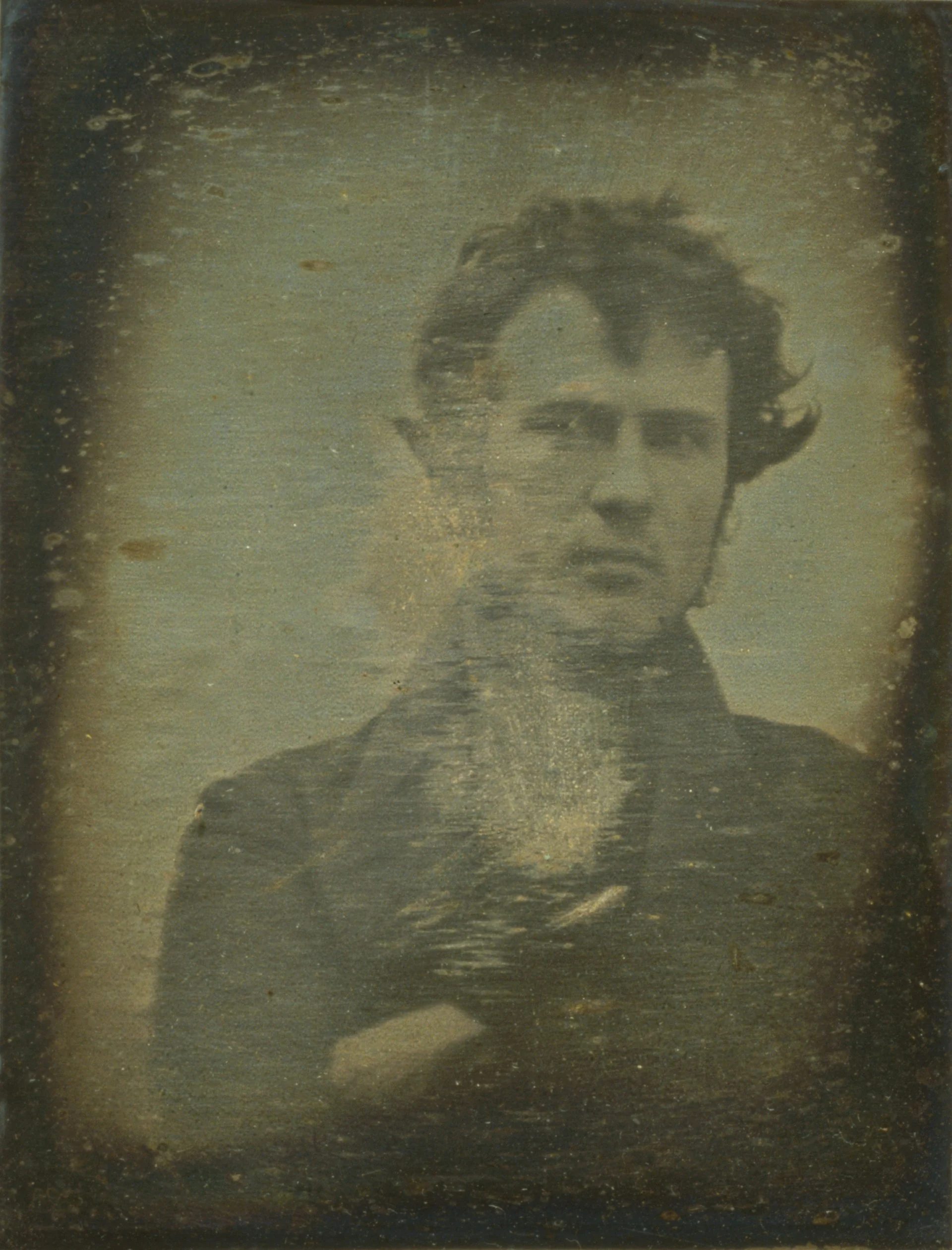
Almost immediately the main argument arose, and it has not ended. A photograph looks like a trace of reality, so one wants to believe it. But the author chooses the point, the moment, the edges of the frame and what will be left outside them. Even the most documentary photograph is not equal to the whole event.
Today a camera can be in every phone, and a picture appears faster than we can take in what we have seen. But the old question remains: what exactly does an image preserve — light, a fact, the author’s eye, or our wish to remember an event in a certain way?
A limitation as meaning rather than stylisation
Another experiment is to examine a family photograph with no caption. What exactly makes you believe it? An awkward pose, the flash, a random edge of a room, a date on the back? Then consider how much information we complete for ourselves: the relations between the people, the mood of the day, the truth of the smiles. A photograph provides visible traces, and memory and cultural habit turn them into a story. The dearer an image is to us, the easier it is to forget the boundary between what was seen and what was supplied.

Modern editing did not invent manipulation. The choice of background, retouching of a negative, a caption and cropping already changed meaning. What is new is the scale and availability of intervention, and above all the difficulty of noticing it. So media literacy begins not with suspicion of everything depicted but with an exact question: what connection to an event does this frame actually confirm, and which conclusions did we add ourselves?
The cost of a frame has moved into attention
There is one more line running from the first processes to the phone: the cost of a frame. When the plate, the preparation and the time were expensive, photographing became a separate event. Now the technical cost of a press is almost zero, while the cost of attention and selection has risen. We can make a thousand pictures in a day, and memory does not become a thousand times richer. Sometimes abundance even dilutes the experience: a person remembers photographing what happened rather than being present in it. The limitation has moved out of the material and into the mind.
Archiving is a continuation of shooting
So archiving is a continuation of shooting, not a dull housekeeping appendix. Folder names, captions, deleting duplicates, keeping originals determine what will be available to a future eye. Without context an important picture becomes an anonymous surface, without copies it disappears along with a device, without selection it drowns in the mass. Early photographs reached us as rare things; our images need a deliberate decision if they are to survive their own ease of production.
Photography was born out of a wish to hold on to vanishing light, but it quickly became a machine of public memory. It determines what childhood, war, scientific proof, crime, beauty and private life look like. Knowing the beginning does not decorate the work with a historical note. It restores a sense of responsibility towards an astonishing construction of trust: the viewer sees a flat surface and still goes on meeting through it what was once in front of a camera.
The history of photography matters not for the sake of a list of inventors. It shows that a technical way of recording changed human behaviour and human trust from the very start. We did not merely learn to hold an image. We learned to live in a world where almost anything can become one.
Notes
- 1A dark room or box with a small aperture in one wall: light passing through it draws an inverted picture of the outside world on the opposite wall. The principle was described in antiquity, and by the seventeenth century the camera obscura was a working instrument for painters — all that was missing was a way of holding what it produced. ↑
- 2Joseph Nicéphore Niépce obtained the first surviving photograph from nature around 1826; Louis Daguerre developed his method into the daguerreotype, a single mirror-like image on a silvered plate; William Henry Fox Talbot took another path and made a negative from which any number of copies could be printed. In effect the last two both won. ↑
- 3First an image with reversed tones is obtained, then any number of positives are printed from it. The daguerreotype was a single copy in the world; the negative made photography reproducible — and so defined its future as a means of communication rather than a relic. ↑