
JournalArt9 min

Delacroix painted “Liberty Leading the People” after the July Revolution of 18301. He was not making an exact report of a single battle. On the canvas a specific Paris street, real types of participant and a woman who is at once a person and an allegory2 all exist side by side.
She walks barefoot across the barricade, raises the French flag and leads the crowd. The classical profile and the bared breast connect the figure with an ancient tradition, while the dress, the movement and the dirt return her to a contemporary event. The symbol does not float above the people — it advances with them.

Delacroix himself did not claim to have fought on the barricades like the people he depicted. In a letter he formulated a more distanced position: if he had not fought for his country, he would paint for it. That does not diminish the power of the picture, but it is a reminder of the difference between a participant and the maker of an image. An artist may not be at the centre of an event and still determine how it will be represented. Such power over an image demands not only inspiration but responsibility for the symbol chosen.
Memory looks for an abbreviation
Large historical events are almost impossible to hold whole. There are too many participants, streets, accidents, contradictory motives in them. Memory therefore looks for an abbreviation: one gesture, one face, one flag. “Liberty Leading the People” became such an abbreviation. Many people recognise the image before they can name the date of the July Revolution or explain its causes. Painting does not merely accompany historical knowledge — it offers it a form convenient for remembering.
Delacroix joins two times. The woman with the banner recalls an ancient goddess and simultaneously steps through Parisian mud. Leave only the allegory and you get an abstract emblem; leave only an ordinary participant in a fight and the scale of generalisation disappears. Their superimposition creates a particular tension: the idea of freedom acquires a body, fatigue and weight, while a specific battle begins to be received as an almost mythological event.
It matters that this figure is not moving somewhere in a safe depth. Her step is directed towards the viewer, and the barricade seems to continue in front of the edge of the canvas. We find ourselves not on a historian’s balcony but at the point where the crowd is about to arrive. The composition shortens the psychological distance. Even someone who does not share the picture’s political pathos is forced to react bodily to the approach.

The price of the movement is put in the foreground
The dead lie below, and their horizontal bodies stop the ascending impulse. This is not a footnote in small type but the foreground. To reach the flag with your eye you have to cross the price of the movement. At the same time the dead can no longer tell their own version, and the artist includes them in the common symbol. Here the difficulty of every heroic image begins: it is able to acknowledge a sacrifice and immediately subordinate it to the larger history.

Different participants are gathered around: a worker, a bourgeois in a top hat, a boy with pistols. That group represents not chance neighbours on a barricade but an image of a people in which classes move briefly in the same direction.
The dead lie underfoot. The painting does not allow a revolution to become only a handsome ascent. The price is already in the foreground, and the viewer literally has to look through bodies to reach the banner.
The composition is built as an ascending movement. The figures and the smoke form a pyramid, with the flag at its apex. The colours of the French tricolour recur in details and tie the chaotic scene together. Even someone who does not know the history reads the direction and the centre of force.

The variety of the crowd is carefully selected
Delacroix’s crowd seems varied, but the variety is carefully selected. The top hat, the working clothes, the boy’s weapons tell the viewer social roles faster than any detailed account. A few figures take on the duty of representing “the people”. Such a device is inevitable: every image abbreviates. But an abbreviation is never neutral. Who was given a place beside the banner, who was left in the smoke, who is shown as active and who only as a body on the ground?
Contemporary photography of an event works in a similar way, only its conventionality is easier not to notice. A photograph looks like a mechanically obtained piece of reality, so compositional choice disguises itself as obviousness. One angle shows the unity of a crowd, another its fragmentation; a long lens compresses people together, a wide one emphasises empty space; the moment of a raised hand turns a gesture into a sign. Everything in the frame really was there, but the meaning arises from how the facts were assembled.
An editor’s choice strengthens that power. Out of hundreds of frames one reaches the cover, and it begins to represent the event for everyone who was not there. Repetition fixes it still more firmly: the image becomes not an example but the visual equivalent of the whole history. Later we may remember the photograph more confidently than the circumstances. So the question of responsibility concerns more than staging or editing. It begins at the moment of selection.
Where in the frame the viewer stands
It helps to analyse a political frame through the viewer’s position. We look from above — and the crowd reads as a mass and a pattern. We are inside it — and we feel the crush and a partial view. We stand facing people who are approaching — and we experience pressure. No position is automatically more honest than another, but each offers a role: witness, participant, object of threat, observer at a safe distance. The author distributes those roles with geometry.
Interestingly, the state’s attitude to the painting changed. It was bought, then removed from public display for fear of its political effect. The image turned out to be not merely a memory of a revolution but a potential call to one.
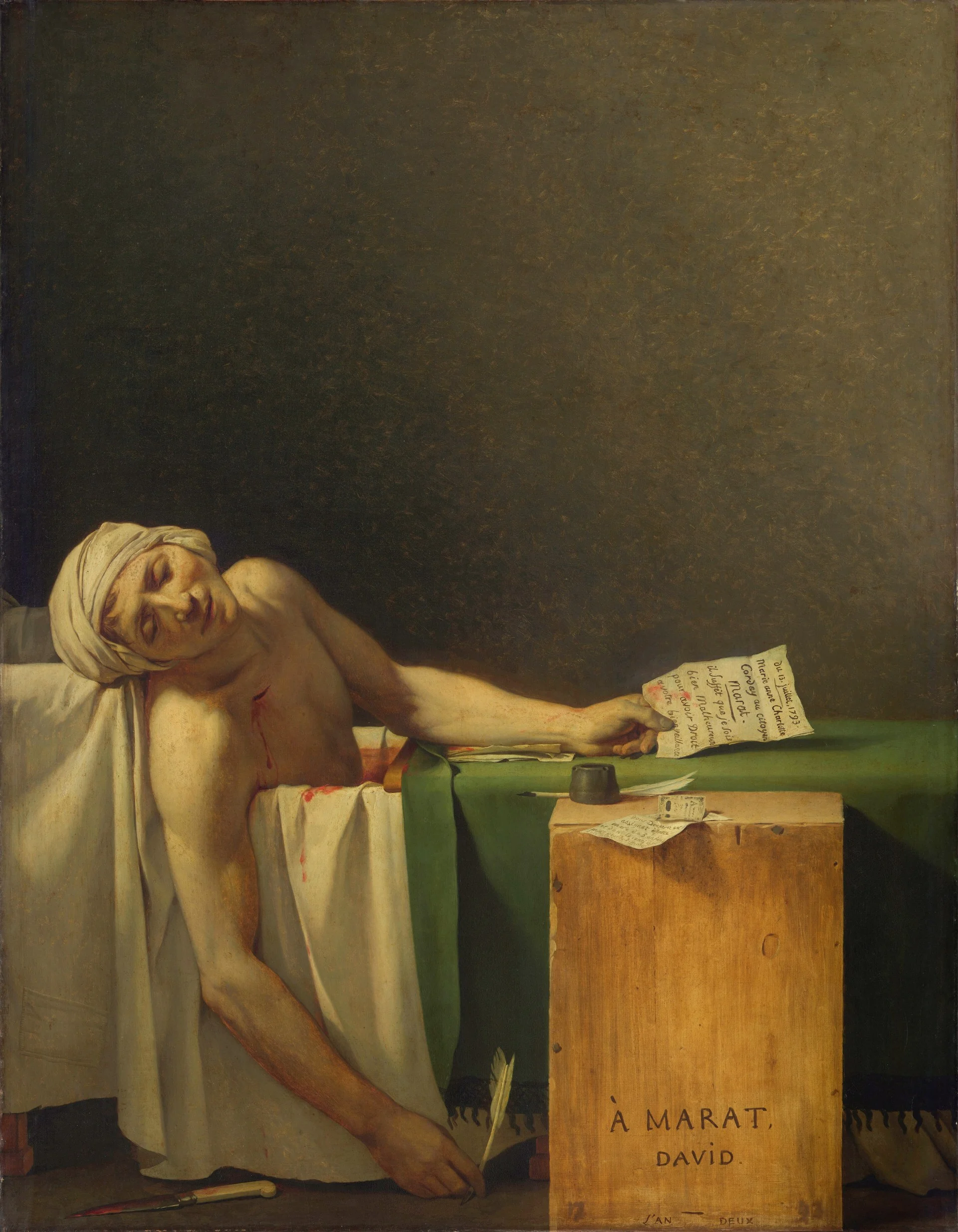
A political image can be tested with a question: where is the viewer inside it? With Delacroix we are almost standing at the foot of the barricade, and the figures are moving towards us. That position makes it impossible to look neutrally from a distance. The composition turns historical knowledge into a personal encounter with an advancing crowd.
That is how strong political iconography3 works. It does not preserve an event neutrally; it assembles the form through which following generations will imagine it. We remember the revolution with a woman and a flag, although no such episode was obliged to happen literally.
A symbol is convenient and therefore open to manipulation
Symbols work because they allow different feelings to be united quickly, but that same speed makes them convenient for manipulation. A flag can denote community, victory, loss or coercion — much is decided by the neighbouring bodies, the light and the camera position. If a symbol is placed at the apex of a composition and lit more strongly than the people, it subordinates them. If it stays small and crumpled among private gestures, the story reads differently.
It is no accident that political images so often quote existing iconography. A raised hand, a forward movement, a triangular group, a gaze beyond the present — the viewer recognises a promise of victory before reading any caption. A quotation saves time and lends a new event the weight of an old myth. But with the weight comes a ready-made script: a complicated contemporary situation starts to look like a repetition of a familiar heroic plot. To see that borrowing behind the form is to regain the possibility of not agreeing to the role imposed on you.

The caption takes part in the composition too
The caption takes part in the composition too, although it lies outside the image. The same frame of a crowd can be called a march, a riot, an uprising or a celebration, and the word will suggest how to read the raised hands. A photographer does not always control that frame, especially in the media, but they should understand its force. When handing over a picture it helps to preserve the exact context: date, place, circumstances, names. The more powerful a visual symbol, the more it needs a factual support that prevents the image from replacing the event entirely.
Simplification is not necessarily a lie
A strong image does not necessarily lie when it simplifies. Without a form an event can scatter into an endless number of details and fail to remain in public memory at all. The question is whether the form admits complexity. In Delacroix a solemn ascent meets the bodies of the dead, an ideal figure meets smoke and dirt, unity meets the difference between participants. The painting convinces without becoming a sterile poster.

Today an image is often required to take an instant position: in one second it must announce who is the hero and who is to blame. “Liberty” shows the power of such clarity and its price. One image can outlive the very political order it was made for and go on mobilising the feelings of people who know nothing about the original conflict. Composition here really does take part in history: it decides not only where to look but in which direction to experience the past.
So a mature way of looking holds two actions at once: it lets the image act and then asks how exactly that was done. An emotional response is not cancelled by analysis; it becomes freer of automatic obedience.
Photography constantly creates images like this too. One frame can become the face of a large event and displace hundreds of other circumstances. So composition is not only a question of beauty. Sometimes it decides which image of history a viewer is left with.
Notes
- 1Three days at the end of July 1830, when Paris answered with barricades Charles X’s attempt to abolish the freedom of the press and dissolve the chamber. The king abdicated, Louis-Philippe took the throne, and with him came a regime that fairly soon stopped pleasing the victors themselves. ↑
- 2An abstract concept shown through a human figure: Liberty, Justice, Mercy. The device is older than painting and rests on a shared vocabulary — the viewer is obliged to recognise the meaning from the attributes. Delacroix risks precisely this by giving his allegory bare feet and the weight of a real body. ↑
- 3A stable set of pictorial decisions by which a subject is recognised without a caption: a raised hand, a triangular group, a gaze beyond the present. A political image needs it as a fast language — and it is the same thing that imposes an old myth’s script on a new event. ↑