
JournalPhotography10 min

When there is one person in the frame, the viewer has little trouble working out where to look. Two usually works out as well: attention holds on their faces, their eyes and whatever is happening between them. But gather a large company in one frame and people turn into a list very quickly. This one is standing, that one is sitting, the rest are also present. Formally everything is in place, and there is no life in it.
The problem is not the number of people as such. The problem is that the viewer’s eye has no route. It catches on the nearest or the brightest face, wanders a little and leaves the frame without ever working out who here is connected to whom.
In contemporary photography those connections can be seen in Annie Leibovitz1, in the staged work of Gregory Crewdson2 and in large advertising portraits where every character is busy with a separate action. The device stays rare for an obvious reason: directing several simultaneous relationships is harder than arranging a group prettily. But you can start small. Instead of building a complex web, find a single chain of three people and check whether it breaks. Even in a family portrait, a child’s glance at a parent and the answering gesture can give more life than a perfect arrangement of every head.
Triangles of attention
One way to hold a group together is to build what are called triangles of attention. The name is slightly misleading: it is not about literally placing three heads at the corners of a geometric figure. Any three points form a triangle without our help. What matters is the connections between people.
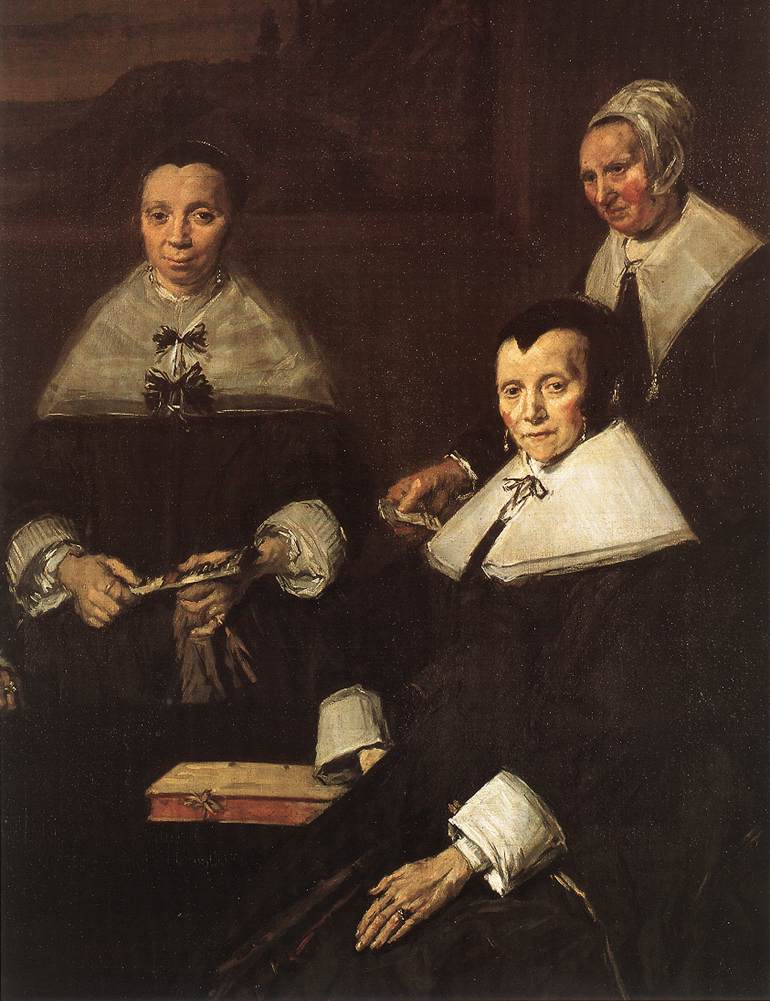
Imagine one person looking at a second, the second addressing a third with a gesture, and the third returning a glance to the first or straight to the viewer. Light can open that chain by picking out the first face, and poses and gestures carry it onwards. The result is a closed route along which the eye travels almost on its own.
That is how many strong group portraits in painting are built. Rembrandt3 knew how to turn a crowd into a system of small interactions: someone is giving an order, someone is listening, someone is distracted, someone has noticed us. We do not examine people one by one, like photographs in a school album. We read relationships.

In photography this device is not there for the sake of a compositional puzzle. It changes the emotional sense of the group. People simply looking into the lens announce: “we have gathered for a photograph”. People bound by glances and gestures say something about closeness, hierarchy, tension or a shared undertaking.

A group is a small society
It helps to stop seeing a large group as a set of faces. What stands in front of the photographer is not ten separate models but a small society already living by its own rules. Someone speaks louder than the rest, someone keeps checking one particular person’s reaction, someone stays closer to the door, and someone habitually gathers the children around them. Miss those connections, line everyone up by height, and you get information about appearance while losing the reason these people ended up together at all. So I would spend the first minutes not rearranging chairs but watching. Sometimes the composition you need already exists — it simply has no light and no frame around it yet.
There is an important difference between the geometric centre and the meaningful one. In wedding photography the couple will almost inevitably be the meaningful centre, but that does not mean their heads have to sit exactly in the middle. You can open the frame with the grandmother’s glance at the bride, lead through the groom’s gesture and return to the viewer through a child’s face. The story stays about the couple, though the way into it runs through other people. That route gives a sense of presence: as if we had not been handed an official poster but walked into the room and gradually understood what matters here.

Light and colour work as stresses
Light in a large group works not as a spotlight for the winner but as punctuation. Light fifteen faces with equal care and the viewer gets fifteen equally loud voices. That is democratic and exhausting. Give one face a little more clarity, a second an edge of contrast, a third a calm dark surrounding, and a rhythm appears. This is not about deliberately “hiding” anyone. A small difference in brightness is needed for roughly the same reason speech needs stresses: without them the words have been spoken, but the meaning has to be dug out.
Colour solves the same task, only less obviously. Say the whole family is dressed in quiet greys and blues, and one person has a warm scarf. Even standing at the edge, they will keep pulling the eye back. Sometimes that is useful — if the story starts with them, for instance. Sometimes the scarf turns a secondary character into an accidental soloist. Asking someone to change clothes is far from always appropriate, but you can change the background, lower the saturation, turn the person differently or support that warm colour in two more places. Then it stops being a shout and becomes a motif.

Glances open the door, gestures hold the connection
The direction of glances is particularly good at creating an invisible edit inside a single image. A person looking past the edge of the frame opens a door outwards and can take the viewer with them. A person looking at a neighbour binds two figures together. Whoever looks straight into the lens suddenly notices us and, in a way, closes the scene. There should not be many direct looks: if all fifteen people address the viewer at once, the frame becomes a statement. One direct look among people busy with each other works differently — slightly uneasy, intimate or ironic, depending on the face.
Gestures are often more reliable than eyes. In a wide shot the direction of a pupil can simply disappear, especially on a phone. The tilt of a body, a hand on a shoulder, a turn of the head, an outstretched arm read even at a small size. So while preparing it helps to scale the photograph down to the size it will be published at. If the relationships are only visible at a hundred per cent, the viewer scrolling a feed will not get them. A good mise-en-scène survives being shrunk: first the large rhythm of bodies reads, then the faces, then the details.

Not every connection has to be friendly. In a corporate portrait the head of the company can stand slightly apart but be turned towards the team; the distance says something about hierarchy, the turn about involvement. In a family scene a person who is physically close but absent in their gaze creates tension. Removing that awkwardness automatically is not always the right move. Sometimes it is exactly the truth of the relationships. A photographer steers emotional perception not only by underlining closeness, but also by letting the viewer feel distance.
Give tasks, not poses
A working way to direct people is to give short tasks rather than poses. “Look at each other” quickly ends in identical smiles. It is far livelier to ask one person to remember a story, a second to interrupt, a third to react without saying a word. You can pass an object across two rows, choose who sits down, or ask the children to show the adults something they found. An action has a reason, and a gesture has an addressee. The photographer is not shooting the execution of a command but the moment when people forget for a second that it exists.
At the same time, direction must not destroy the character of the group. It is odd to impose solemn stillness on a noisy company, or advertising jollity on a reserved family. The most convincing frame is not necessarily the most active one. Sometimes a quiet chain is enough: one person reads, another listens, a third watches them both. The route exists although nobody is waving their arms. The intensity of the connections should come from the real relationships, not from a set of fashionable poses.
Three layers worth checking before the shutter
Before the final press I would check three layers. The first is silhouettes: have the heads merged, is the overall mass clear. The second is the route: where the eye enters and where it lingers. The third is meaning: does the visual leader coincide with the person this scene is about. A technically flawless frame can fail precisely on the third layer. We light the person in red magnificently, although the story was meant to be built around the quiet one in the depth.
And one more useful test: take the colour away, then shrink the photograph hard. Monochrome reveals the hierarchy of light, the thumbnail reveals the large rhythm. Then bring the colour back and see whether a second, competing route has appeared. This is not a recipe for post-processing but a way to hear the frame part by part. When light, colour, gestures and glances tell one story, the group stops demanding effort. We are no longer counting people — we understand what is going on between them.
There is one more check that is convenient to run after the shoot. Open the series not frame by frame but as a sheet of thumbnails and see whether the same scheme repeats everywhere: the main person in the centre, everyone else neatly distributed along the edges. If it repeats, the trouble is not that the scheme is bad. It simply stops saying anything about this particular group very quickly. In one case the first person may be the one who makes everybody laugh, in another the most silent one, the one people quietly listen to. A good edit keeps not the most impeccable formation but the pattern of relationships that could not be transferred to another company without loss.
That is why a group portrait is rarely saved by one lucky arrangement. People move not only physically: someone is tired, someone has taken offence, a child has reached for their mother, the boss has stopped being the boss for a second. Those short shifts are the material. What matters is to build a clear framework in advance and then not sleep through the moment when life disturbs it slightly. In such a frame the composition stays assembled, but it no longer looks like proof that everybody diligently followed instructions.

Before a shoot it is worth asking not only whether there is room for everyone and whether the faces are clearly visible. Something else is far more interesting: who sets the tone here, who leans towards whom, who keeps apart, and where the viewer should go after the first glance. Once those relationships appear in the frame, the group stops being a crowd. It becomes a scene worth staying in.
Notes
- 1An American portraitist who has shot for Vanity Fair and Rolling Stone. In her large staged groups each character is usually busy with an action of their own, and the connection between them rests on glances and gestures rather than on a shared turn towards the camera. ↑
- 2An American photographer who builds a frame like a film set: light, props and mise-en-scène are prepared in advance, and the characters are introduced into an environment that is already assembled. ↑
- 3Seventeenth-century Dutch group portraits were commissioned and paid for by the sitters themselves — each contributed a share. Hence a task familiar from any corporate shooting day: show everyone without lining everyone up. ↑