
JournalArt10 min

Great periods end awkwardly. There is no morning on which artists wake up and realise that the High Renaissance is over and from Monday we work differently. The old language goes on existing, but it fits the world less and less.
For several centuries the Renaissance was built around confidence: in the human being, in reason, in the harmony of the body and in the possibility of joining knowledge to beauty. By the sixteenth century that confidence had begun to crack. Wars, religious conflict, political instability and new scientific ideas fitted badly into a picture of the world in which a person felt like its natural centre.
Put a clear composition by Raphael beside a late Mannerist work and the change is felt in the body: the stable centre gives way to sliding, the natural pose to demonstrative complexity. Such a viewing is more useful than a date in a textbook. The period becomes visible not as a term but as the loss of a former calm.

Even geographically the decline was uneven. Venice lived by its own rhythm and held on longer to the colour and calm of the High Renaissance, while other centres were already looking for another language. A common cultural ether was still far off: ideas travelled with people, commissions and workshops.
The crisis also touched the old dream of a person able to combine art, science, physical and spiritual life in harmony. The new reality pulled those areas apart. The split cannot be dated to a single picture, but its mood is palpable: an ideal figure no longer guarantees an ideal world. The more perfectly an artist preserved the flawless form, the more visible its artificiality could become. Mannerism turned that artificiality into the subject of art and stopped pretending that balance still came naturally.
Artists reacted to the crisis differently. Some stretched the figures, complicated the poses, made space deliberately unstable. So Mannerism1 appeared, in which ideal anatomy seems to have grown tired of being ideal and started to bend. Colour could become strained, composition almost artificial.

Others intensified movement, chiaroscuro and bodily presence. Out of that direction the Baroque would grow: an art that does not so much display harmony as pull the viewer into an event. Its light does not lie calmly on form but bursts in and seizes the essential.
The late Renaissance is sometimes described as decline. But the word is too simple. When old ideals stop convincing, form does become nervous and contradictory. That may look less perfect, and it conveys the state of the period more precisely.
Such moments repeat. We notice the end of a cultural language when its habitual solutions start to look beautiful without explaining what is happening. That is when art does strange things: exaggerates, breaks proportions, mixes the exalted with the everyday.
Forget the textbook arrow between dates
To feel the end of the Renaissance it helps to forget the schoolroom arrow between dates for a while. Imagine an artist with a magnificent command of the language of harmony: able to build perspective, versed in anatomy, at home with antiquity, arranging figures so that the world looks reasonable. And suddenly the problem turns out not to be one of skill. The language is still beautiful, but it stops coinciding with experience. Events around are too nervous, faith is split, politics unpredictable, and the familiar confidence in the human being no longer sounds unconditional.
In 1527 the sack of Rome was not the sole cause of the change, but it was a powerful symbol. A city bound up with papal power and cultural prestige lived through a catastrophe. Workshops scattered, patrons changed their plans, the sense of a protected centre disappeared. You cannot say Mannerism arose the following day. But after events like that, ideal equilibrium starts to be perceived not as a natural truth but as an effort — sometimes magnificent, sometimes too visible.

The Reformation and the Catholic response also changed the standing of the image. The argument was not only about theology but about what a picture is entitled to do to a believer. May it seduce with beauty, must it be comprehensible, does form obscure content? The decisions of the Council of Trent2 handed artists no ready stylistic code, but they defined the religious and disciplinary role of the image more sharply. The tension itself had arisen earlier: a master worked not in a neutral museum but inside an argument about the power of images.
Mannerism is an excess of knowledge, not a lack of it
Mannerism is often described by a list of oddities: elongated bodies, complicated poses, unusual colours, unstable space. The list is accurate and explains nothing until we catch its tone. This is the art of someone who knows the classical rule so well that simply following it feels like repetition. A figure stretches not from ignorance of anatomy but from a surplus of knowledge and the wish to step beyond the natural. There is virtuosity in it, and anxiety, and a little of “look what I can do”.
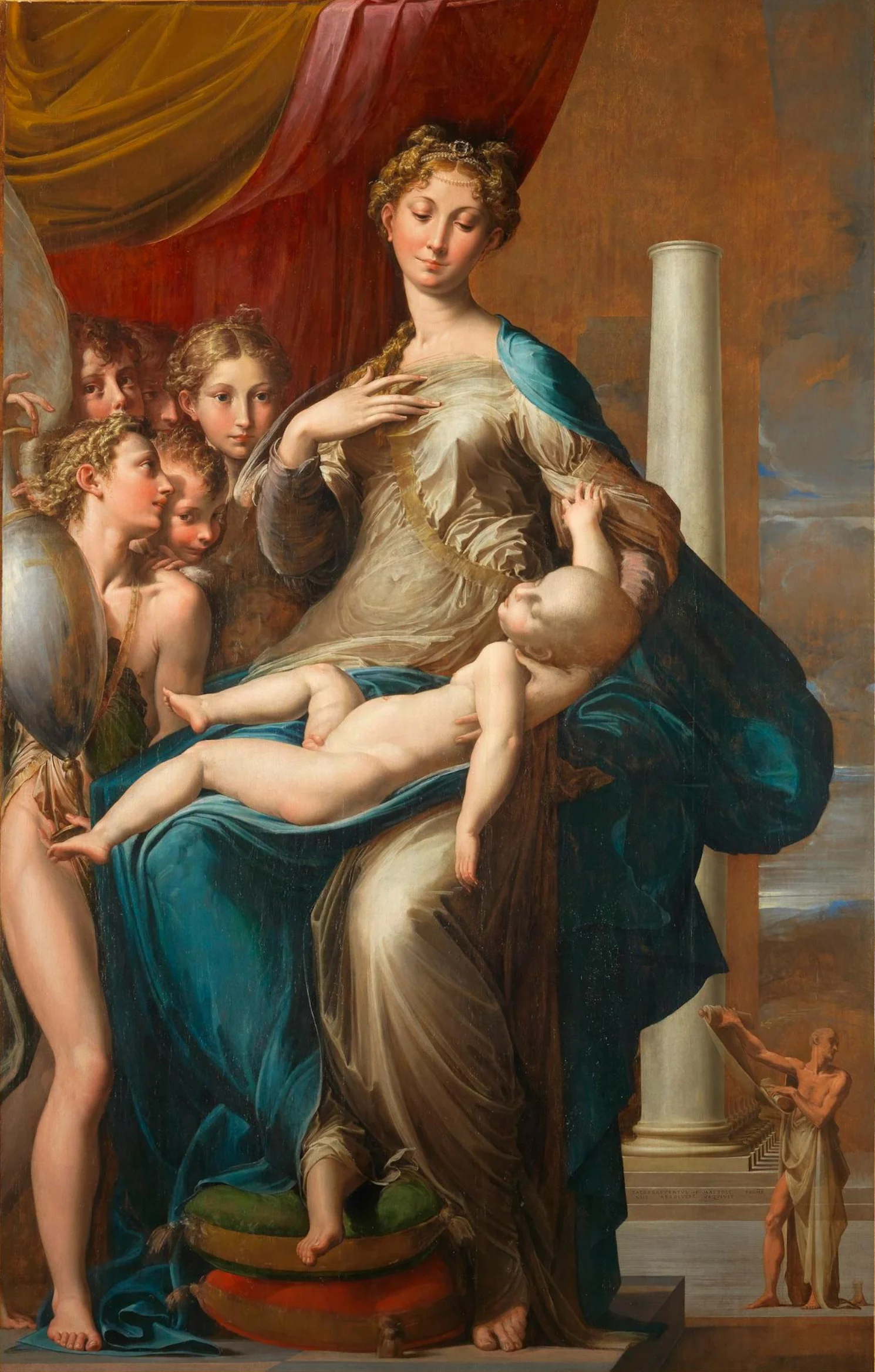
In Parmigianino’s “Madonna with the Long Neck” Mary’s body becomes almost impossible, the space refuses to gather into familiar clarity, and a small figure in the background looks as though it belongs to another scene. Measured by Raphael’s yardstick, the painting is easy to declare mistaken. But the viewer gets a different feeling: beauty here does not calm, it puts you on guard. The ideal has become too thin, too stretched, too fragile — as though it understood itself that it cannot hold on for long.
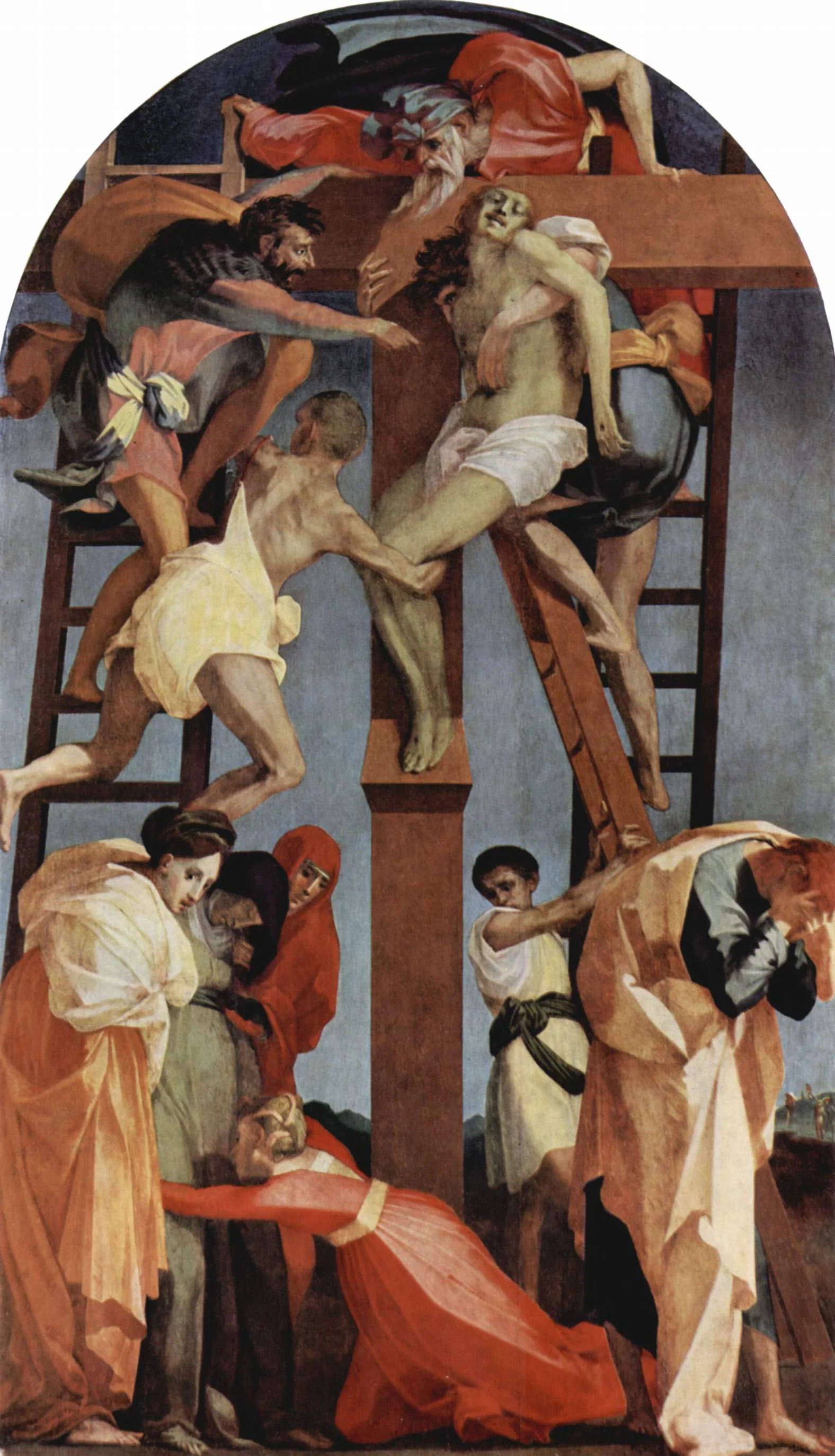
Pontormo goes further still with colour. In his “Deposition” it is hard to find the usual weight of the earth; the figures seem to float in an acid-tender space. This is not realistic light, and precisely for that reason the scene works emotionally. The bodies obey a shared state of shock more than they obey physics. Colour stops describing matter and starts tuning the viewer’s nervous system directly — a device contemporary photography uses eagerly in colour grading.

The sunset of the period looked different in different places. Venetian painting, with its attention to colour, air and surface, was under no obligation to repeat the Florentine crisis of drawing in step. Titian could preserve the fullness of a sensuous world and at the same time dissolve form in his late works. El Greco3, formed at the crossing of Cretan, Venetian and Spanish traditions, would turn elongation and supernatural light into an entirely personal language. History moves not in formation but at several speeds.

The Baroque answers the same crisis differently
The Baroque answers the crisis in another way. It gives the viewer comprehensible bodily presence back, but strips it of calm. Caravaggio brings the sacred scene close to a dark room and picks the event out with harsh light. Bernini makes stone continue its movement around us. The point is no longer only to show perfect form but to draw a person in, shorten the distance, make them a witness. Harmony gives way to experience.
What follows from this for a photographer
For a photographer there is a practical connection here. When we shoot an anxious time in the language of flawlessly balanced advertising, the form can start to lie. That does not mean the horizon must be tilted and the colour cranked up. The question is deeper: does the clarity we have chosen match the state of the scene. Sometimes emptiness, an awkward perspective, a stretched silhouette or a cold rupture between planes conveys the experience more precisely than an exemplary composition.
Colour shows a change of cultural language particularly well. A natural hue is not always psychologically truthful. A camera can record skin tones and neutral shadows accurately, and the viewer will be left too calm. If the task is to convey the feeling of a world that has lost its balance, the colours can be pulled apart: make the light almost painfully warm, the shadows alien, let the hues refuse to reconcile. The Mannerists did the same with paint long before the words “grading” and “colour script”.
The end of a language is recognised by a discrepancy
We recognise the end of a period today by the same strange discrepancy: the familiar form is still everywhere, and trust in it has gone. The old genres go on being produced, yet new authors start to exaggerate, to mix, to quote with irony, to break the smooth surface. The public often takes this for incompetence or a wish to shock. Sometimes it is. But sometimes a nervous form is more honest than a calm one, because the calm world it was supposed to depict no longer exists.
So the end of the Renaissance is interesting not as the funeral date of a great period. It is a lesson in the fact that a cultural language dies before the craft does. Artists may still command proportion and perspective beautifully and no longer believe those things explain reality. The new begins at the moment of that awkwardness. At first it looks wrong, too long, too dark or theatrical. Later it turns out that it was through the mistake that the time first managed to tell the truth about itself.
Meanwhile the old language does not vanish instantly. It goes on living in workshops, provincial commissions, religious images and the tastes of people under no obligation to feel the crisis in step. The new always sits next to the old that still works perfectly well, and sometimes borrows its authority. So the end of a period is easier to see not as one set of devices replacing another but as a loss of monopoly: harmony remains possible, and stops being the only convincing way to speak about the world.
A period ends not when its masters disappear. It ends when the next artist can no longer speak honestly in the old voice.
Notes
- 1The word comes from the Italian maniera — “manner”, “hand”. At first it was praise for mastery; in the seventeenth to nineteenth centuries it turned into a reproach for affectation; and only in the twentieth was Mannerism recognised as a language of its own rather than a defective marriage of Renaissance and Baroque. ↑
- 2The council sat from 1545 to 1563 and in its final session spoke about images: a picture should teach and lead to faith, not confuse with obscurity and excessive licence. It handed artists no stylistic code, but it defined the role of the image more strictly. ↑
- 3Doménikos Theotokópoulos, a Cretan trained on icons, who worked in Venice and settled in Toledo. His elongated figures grew not out of the Florentine argument about drawing but out of an entirely different set of traditions — which is why they read as a personal language rather than a late fashion. ↑