
JournalArt10 min

Art history loves posthumous recognition, which makes Michelangelo’s fate look like an exception. His contemporaries already considered him great. He worked for popes, rulers and influential families, lived almost eighty-nine years and had time to watch the age he personified change in front of him.
He began very early. At thirteen he entered the workshop of Domenico Ghirlandaio1, then studied sculpture in a circle supported by Lorenzo de’ Medici2. Alongside the craft there was philosophy, politics and acquaintance with people who would later stand at the summit of church power. The talent did not develop in a vacuum — it landed straight away among big ideas and big patrons.
Michelangelo worked in architecture, painted and wrote poetry, but considered himself above all a sculptor. You can feel it even on the Sistine ceiling: the bodies look solid and heavy, as though the artist had not painted them but freed them from the surface.
The legend of the genius easily erases the inconvenient part of the work. Behind the famous results stand years of physical labour, conflicts with patrons, projects that changed or were never finished. The tomb of Pope Julius II turned into a decades-long story of cuts and disappointments. Fame did not release the author from other people’s power or from his own doubts.

He hardly ever signed his works, and the Vatican “Pietà” remains the only known one with his signature. A late account by Vasari3 explains it by injured pride: Michelangelo supposedly overheard the sculpture being attributed to another master and carved his name at night on the band across Mary’s breast. The anecdote is a fine one, though its reliability is debated; the inscription in the marble is a fact, the motive already belongs to legend. Even the biography of an acknowledged genius consists of those two layers.

Even after his death Michelangelo’s biography went on working as the story of a national genius. He died in Rome, but the body was secretly taken to Florence and buried with ceremony in Santa Croce. Cities and rulers competed not only for the living master but for the right to call him theirs. That shows clearly how far the status of an artist had, by the end of his life, moved beyond the craft. Michelangelo was not simply an executor of papal commissions but a figure through which the age described its own greatness.
A long life made him a bridge between periods. The early works embody the clarity and force of the High Renaissance; the late ones grow heavier, more inwardly troubled, and already sense a new art coming.
“Genius” in hindsight works like a solvent
The word “genius”, applied in hindsight, works like a solvent. It removes from a biography the people, the money, the workshops, the contracts, the accidents, and leaves one shining talent. With Michelangelo this is especially noticeable: it seems as though the marble itself waited for his touch, the popes patiently paid for any idea, and the Sistine ceiling was painted in a single burst. The real story is far less smooth — and that is exactly why it is more useful.
The Florence he grew up in was not only a city of beauty but a harsh political environment. The Medici patronage gave access to antique sculpture, humanist conversation and influential acquaintance. It also tied the artist to a system of power that could change faster than a fresco dried. The talent landed in exceptionally fertile ground, and that ground was not a neutral academy for gifted children.
The early “Pietà”: an almost impossible task
The early “Pietà” astonishes for more than technique. A young author solves an almost impossible emotional problem: to show a dead adult body on its mother’s knees without destroying the composition with its weight. Mary turns out younger than expected, the folds of cloth create a broad base, the marble becomes skin at one point and fabric at another. This is not “realism” in the simple sense but a carefully constructed experience. The viewer is given both the bodily truth of death and the ideal distance that makes it possible to look.
“David”, too, has long since become a souvenir, which makes it hard to give him back his original tension. This is not a relaxed victor after the deed but a man before the action. The gaze is gathered, the hand enlarged, the body ready and still motionless. The Florentines saw a civic symbol in it: a small republic against powerful enemies. The sculpture worked not only as a display of anatomy but as a political image of a city that wanted to see itself as brave.

The other side of success
The commission for Julius II’s tomb shows the other side of success. The original project was grandiose, then the plans were cut back, contracts changed, the pope’s attention moved elsewhere, the artist left and returned. For several decades one idea followed Michelangelo about as an unclosed promise. “Moses” and the figures of the slaves exist today as independent masterpieces; for their author they were part of a history of compromises. Recognition does not cancel the fact that a large work can end up other than it was conceived.

The Sistine ceiling added a convenient picture to the myth: a solitary master lying under the vault and painting heroically. He did carry an enormous responsibility and did a great deal himself, but the project required scaffolding, assistants, preparation of the surface, the organisation of materials. Something else matters more: a sculptor had to think in painting on an architectural scale. He did not simply place separate scenes but created a system in which the body became the language of a cosmic history.

When the “Last Judgment” appeared decades later, the mood was already different. The figures revolve in an enormous current, the confidence of the early Renaissance gives way to tension, and the body becomes powerful and vulnerable at once. Contemporaries argued about the nudity; later some of the figures were covered. Even an artist with an almost official status of genius did not exist outside the control of his age. Power could glorify him and at the same time correct whatever it considered permissible.
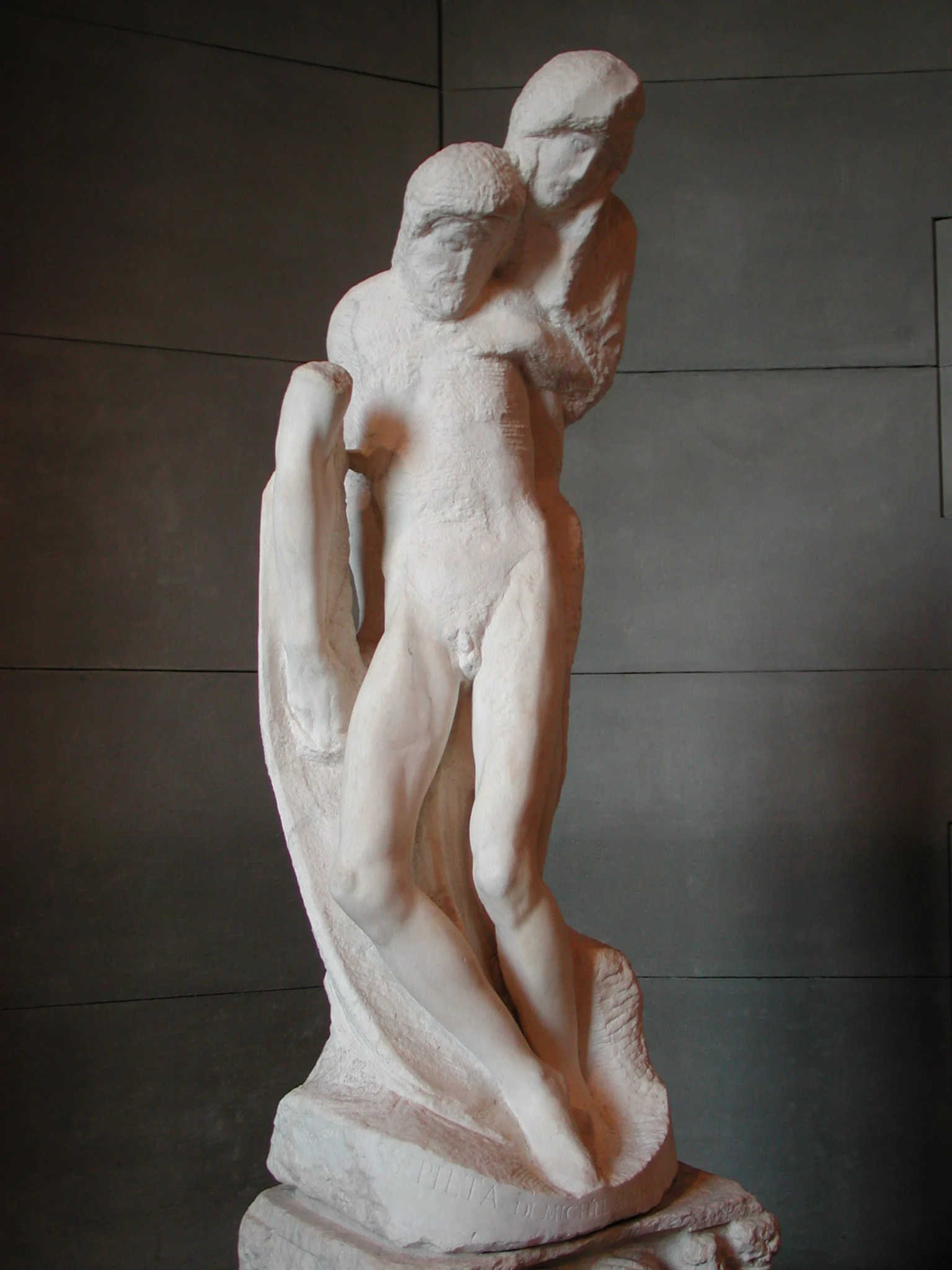
The late Pietàs matter especially if you want to see a person rather than a monument. The surface becomes less finished, the composition inwardly heavier, the theme of death takes on a personal sound. One of the groups Michelangelo damaged himself, perhaps out of disappointment with the stone or with the result. That gesture fits badly on a postcard about an unerring master. But it is recognisable to any author: sometimes a high level offers no protection from the feeling that the material has refused to become what was intended.
Being a genius in your lifetime is also a public role
Michelangelo knew how to defend his position, argued about payment, and was painfully sensitive about rivals and about his own image. Being a genius while alive is also a public role that has to be maintained. The patron expects the impossible, contemporaries compare each new thing with the last, apprentices and competitors watch for mistakes. The higher the reputation, the less room there is for ordinary, tentative work that may not come off.
There is a paradox: recognition gives freedom of choice and at the same time makes an author the prisoner of their own name. Michelangelo was expected to produce a Michelangelo scale. He could not calmly bring in a small, doubtful solution and ask not to be judged harshly. Contemporary photographers know a scaled-down version of that trap: a successful series becomes a style, the style becomes what clients expect, and the expectation starts dictating the next job.
A practical lesson: separate the result from the process
The practical lesson here is not to work until ninety and quarrel with every client. Rather, it is to separate the result from the process. A great thing can be born of an unpleasant commission; an unfinished project can yield discoveries; status does not exempt anyone from the craft; a conflict does not always prove principle — sometimes it is just a conflict. A biography grows up when we stop turning every difficulty into elegant evidence of destiny.
The most human thing in Michelangelo is not a supernatural ability but the impossibility of putting a full stop. He changed along with his long life, returned to the body, to stone, to death, to faith, and needed a smooth demonstration of strength less and less. Being a recognised genius turned out to be not a finale but a particular kind of responsibility: to go on working after the people around you are ready to turn you into a monument.
The reputation of a genius is a work too
It is curious that the myth of Michelangelo was not created only by posterity. Biographies came out in his lifetime, he himself took care over how his story would be told, and versions convenient to different participants were already forming around the commissions. That does not diminish the scale of the work, but it is a reminder: the reputation of a genius is also a work — collective, and not entirely disinterested. Some episodes in it become symbols, others disappear, and a disputed anecdote comes in time to sound more convincing than a dull contract.
The late Michelangelo is particularly awkward for the poster image of a victor. There is less wish in him to present a perfect body and more talk of weight, faith, death and the impossibility of finishing. A long career did not freeze at the “David” and the chapel ceiling; a man who had already been made a measure of greatness in his own lifetime went on changing. That is perhaps the strongest answer to the question of what it is like to be a recognised genius: not to believe that a public title exempts you from the next doubt.

What is interesting in Michelangelo’s biography is not only the scale of the gift. It shows that recognition neither completes the work nor turns a life into an uninterrupted triumph. You can be appointed a genius while alive and still spend decades arguing with material, deadlines, power and your own idea of what is possible.
Notes
- 1A large Florentine fresco workshop working for the leading families of the city. An apprentice there began by grinding pigments and preparing walls — the school was a craft one, not an academy. ↑
- 2Lorenzo de’ Medici, called the Magnificent, the effective ruler of Florence. The collection of antique sculpture he assembled in the gardens of San Marco was the adolescent’s principal textbook. ↑
- 3Giorgio Vasari, painter and the first historian of art: his “Lives”, published in 1550 and 1568, came out in Michelangelo’s lifetime and largely set the image of the genius we are still dealing with. ↑