
JournalArt10 min

In Fuseli’s painting a woman lies across a bed, her arms hanging limp, her body arched. A small heavy creature sits on her chest, and a horse’s head with white eyes emerges from a dark curtain. The scene is absurd and extremely unpleasant at once.
Fuseli painted “The Nightmare” at the end of the eighteenth century, when art was becoming interested not only in reason and order but in what happens beyond their border. The picture does not illustrate a known literary subject. The viewer is left in front of a dream that cannot be retold exactly.
If you remove the creature from the chest, the woman’s pose stays disturbing. If you keep the creature but seat the figure calmly, the bodily truth of the nightmare disappears. Fuseli joins a fantastic object to a very recognisable state of the body; it is that join which makes the impossible convincing.
Fear begins with a bodily analogy
“The Nightmare” acts almost indecently fast. We have not yet worked out who these characters are or where the action takes place, and our own chest already remembers the weight. Fuseli begins not with a plot but with a bodily analogy. The woman lies in a way that looks uncomfortable even to an observer; the arms have lost their support, the throat is open, the fabric emphasises helplessness. The fantastic creature becomes convincing because it sits down on a sensation we already understand.
Fear rarely requires a full display of the threat. On the contrary, an over-detailed monster quickly becomes an object of examination: you can assess its anatomy, its costume, the quality of the effect. A partly hidden presence gives no such distance. The horse’s head emerges from the curtain, and the space behind the fabric stops being the ordinary depth of a room. Anything you personally know how to fear can be there.

The room in the painting resembles both a stage and a trap. The light picks out the body, the background becomes dense, there are almost no exits. Theatricality1 does not weaken the fear, because a dream itself builds a world like bad theatre: one object suddenly lit, the scale broken, the impossible accepted without explanation. What we recognise is not a real bedroom but the logic of a nightmare.
The monster looks outwards
The gaze of the creature on the chest is especially unpleasant. It is not busy attacking and does not look seized by rage. It sits calmly, as though it had a right to be here, and looks outwards. The viewer has been noticed by the monster. That small exchange of roles destroys the observer’s safe position: we are studying the scene, and the scene has already answered with a look.

The English word “nightmare” is historically linked not simply with a bad dream but with a creature that presses down on a sleeper. The figure on the chest makes that old bodily explanation literal. A modern reader may recall sleep paralysis2: consciousness is already awake while the body will not move, and a presence in the room feels real.
Fuseli exhibited the painting in a way that quickly attracted attention, and then made other versions. The image proved suitable for reproduction and parody: the monster could be seated on the chest of a politician or of society, turning a private nightmare into satire. It is a good example of how a strong compositional scheme detaches itself from the original work and begins to live as a meme3 long before the internet. What stays recognisable is the pose of helplessness and the creature that makes use of it.

The horse adds a verbal and visual pun but does not explain the scene. It looks out of the darkness too close, breaking the ordinary space of the room. We are not sure whether it exists beside the woman or only inside her dream.
Horror is not a quantity of frightening details
Visual horror is often confused with the number of frightening details. Blood, harsh light, a distorted face can announce a genre but do not necessarily produce a feeling. Fear arises out of relations: a familiar space behaves wrongly, a body cannot perform a simple action, the border between dream and room will not close. Fuseli gives us a few impossible elements but ties them to a precise human vulnerability.

For a photographer an interesting principle follows: first find the norm, then break it in one place. An ordinary bedroom with a barely wrong distance between a person and the door can be more disturbing than the set of an abandoned house. Domestic light promises safety, but too deep a shadow behind someone’s back cancels the promise. The viewer does not immediately understand the cause of the discomfort and therefore goes on looking.
The camera position decides whose fear we catch
The camera position determines whose fear we catch. A high viewpoint makes a lying person small and available for observation; a low one brings us close to the edge of the bed and to the presence of the threat. A very close frame removes information about the room and makes us complete it; a distant one shows the absence of an exit. Those decisions matter more than the decorative blue tint often used to denote night.
Colour can work bodily. Warm skin against dense darkness seems alive and therefore vulnerable; a cold shift distances and makes the scene resemble a memory or a stupor. Red does not necessarily mean danger directly. Sometimes a small warm area in a cold space draws the eye to where the viewer is not yet ready to see the source of the anxiety.
The light picks out the body almost theatrically. White clothing and skin separate sharply from the heavy red and black around them. Vulnerability becomes visible while the source of the threat stays partly in darkness.
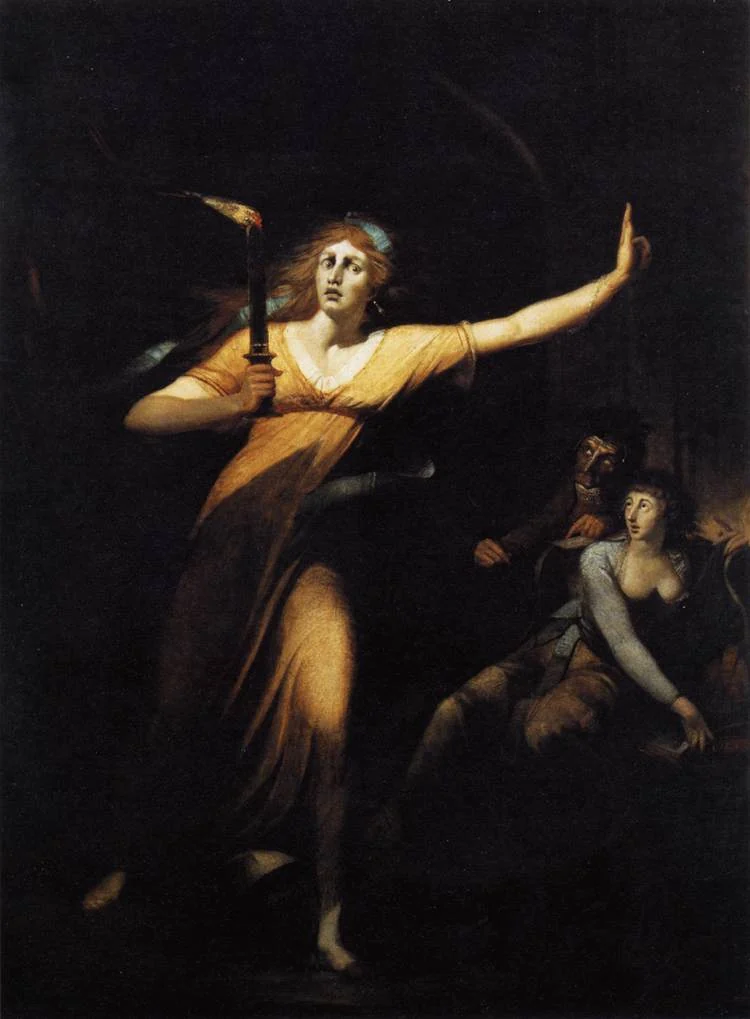
The painting quickly became famous; it was copied and reinterpreted. Perhaps because Fuseli found a form not for a particular monster but for a familiar sensation: your own body no longer obeys you, the room stays the same, and an alien presence has appeared in it.
A frightening image need not show violence. Sometimes it is enough to change the relations between a body and a space. A low viewpoint, a weight on the chest, a curtain with something looking out of it — and the viewer remembers fear before they can name the subject.
A list of violations rather than a list of props
The moment before the event matters no less. A face already distorted by a scream closes off many possibilities; stillness a second before the reaction leaves them open. In “The Nightmare” the action has strangely both already happened and is still going on. The creature sits, the woman is drained, the horse is only appearing. Different stages are held in one construction, so the frame does not turn into a frozen illustration.
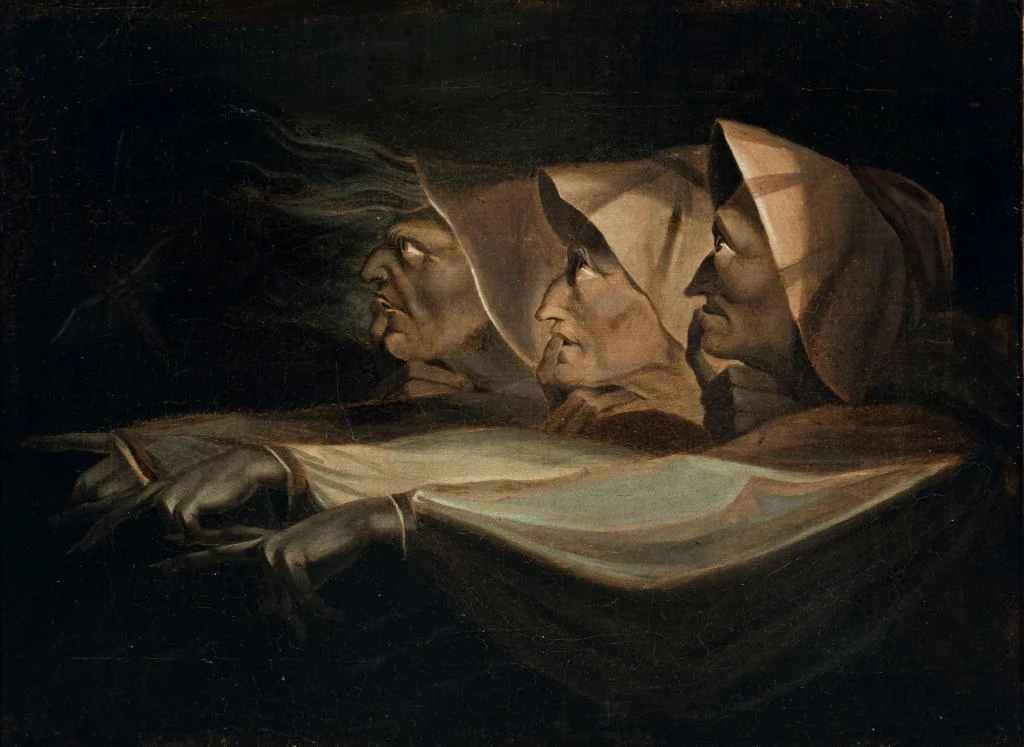
The popularity and parodiability of the composition show that a strong image can be transferred to new fears. It is enough to replace the figure sitting on the chest — with debts, a politician, an illness, a public anxiety — and the scheme reads again. It is an early example of a visual template that stays expressive thanks to a simple arrangement of forces: a helpless body, a weight and a witness out of the darkness.

Transfer the principle, not the props
But repeating a strong scheme carries a risk: the viewer recognises the quotation before they have time to be frightened. The image then works as a witty reference rather than as an experience. If the task is more serious than parody, it is better to transfer not the outward signs of the painting but the principle. Do not seat a literal monster on a chest; find a contemporary form of pressure. Do not copy the red curtain; build a border beyond which the space stops obeying the norm. A living reference passes on relations, not props.
There is no sound on the canvas, and the painting makes you imagine it. The heavy silence of the room, a possible breath, the rustle of fabric become part of the fear precisely because you are not allowed to hear them. Photography can also summon sound through visible causes: a half-open door, a tensed jaw, an object on the edge of falling. The more exact the visual hint, the more actively the viewer builds their own acoustic scene and the deeper they enter the image.
In a series, fear is built up by narrowing freedom
In a series fear can be built up not by the appearance of ever more frightening objects but by a narrowing of freedom. At first the room seems ordinary, then it recurs with a small violation, then the subject is closer to the edge of the frame and the exit has gone. The viewer gets used to the space and therefore notices the changes bodily. This slow work is the opposite of a sudden effect, but it leads to the same place Fuseli found: the familiar no longer guarantees safety.
The painting can be analysed afterwards; you can recall the history of the word “nightmare”, name a possible sleep paralysis. Explanations are useful but do not cancel the order of the encounter. First we feel the pressure and the loss of control, then we look for a language for them. That is Fuseli’s precision: he does not ask the viewer to believe in a particular demon. He restores the state in which any shadow is granted, for a second, the right to become one.
That is why the painting does not age along with belief in night spirits. The monster may look theatrical and the horse almost comic, but the machinery of helplessness stays contemporary. We change the explanations, and the body’s memory recognises the impossibility of moving, the weight and the alien presence. The artist reached deeper than a particular superstition — into the layer of experience where reason has not yet organised the fear and therefore cannot protect us from it.
“The Nightmare” acts before any explanation. That is exactly why every precise interpretation arrives a little late: the body understood the painting first.
Notes
- 1Building a scene by the laws of theatre: directed light, a dark backdrop, figures turned towards the viewer. In painting the device usually weakens credibility — we see a staging. Here it works the other way round, because a dream itself is arranged like bad theatre: one object suddenly lit, the scale broken, the impossible accepted without explanation. ↑
- 2A state on the border between sleep and waking: consciousness is already working while the muscles are still switched off. It is often accompanied by a feeling of weight on the chest and of an alien presence in the room. Before this had a name, the explanation was precisely a creature sitting down on the sleeper — and Fuseli painted the explanation literally. ↑
- 3A form that has detached itself from its source and lives on, changing its content: the pose of helplessness and the weight on the chest can be filled with anything — debts, a politician, an illness. The word is new, the phenomenon old: “The Nightmare” was being parodied within a few years of its first showing. ↑