
JournalArt10 min
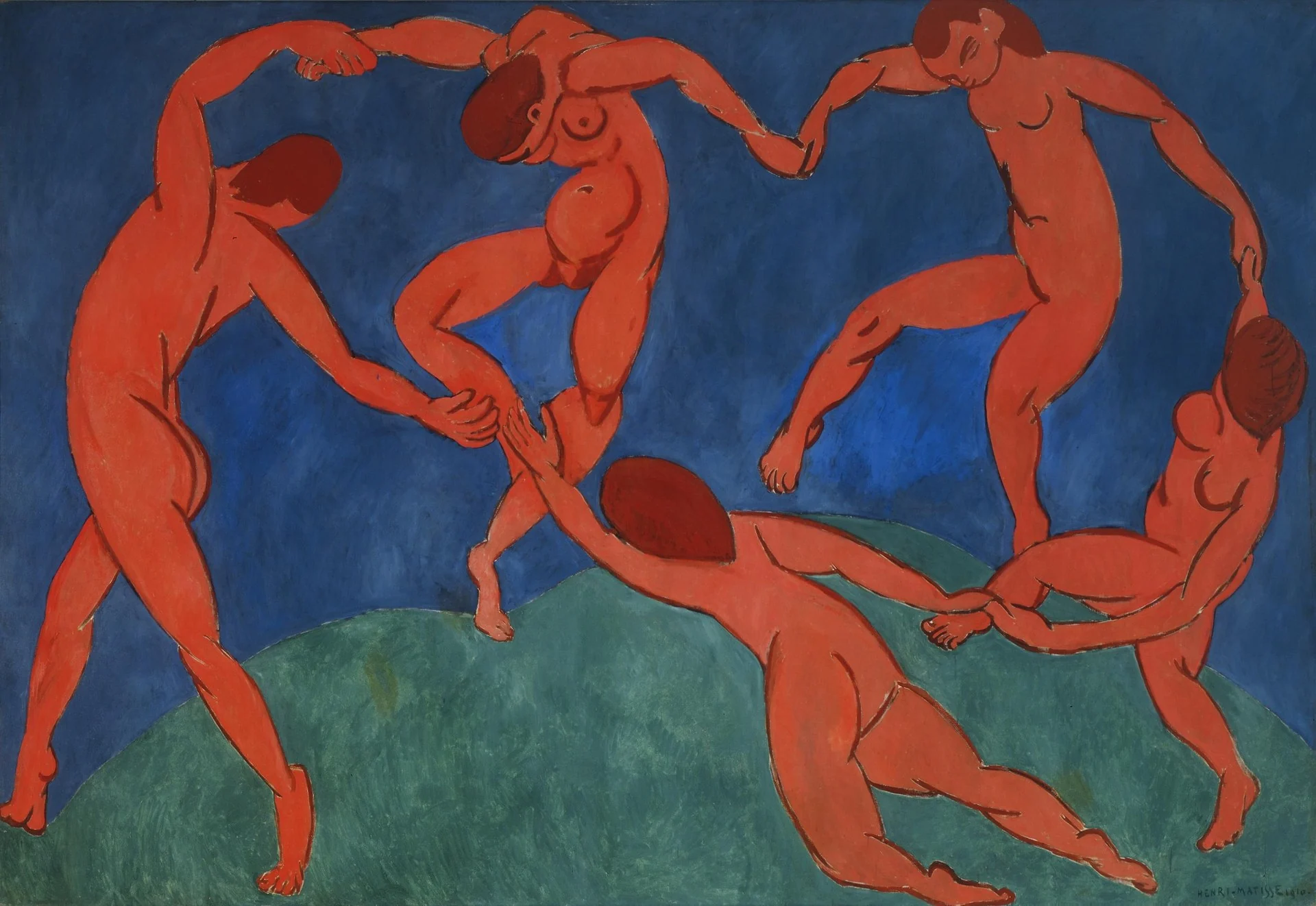
There is almost nothing to enumerate in Matisse’s “Dance”. Five naked figures hold hands, green ground beneath them, blue space behind. There is no architecture, no complicated light, no individual faces, no detailed subject. And yet the painting acts as though far more were happening in it.
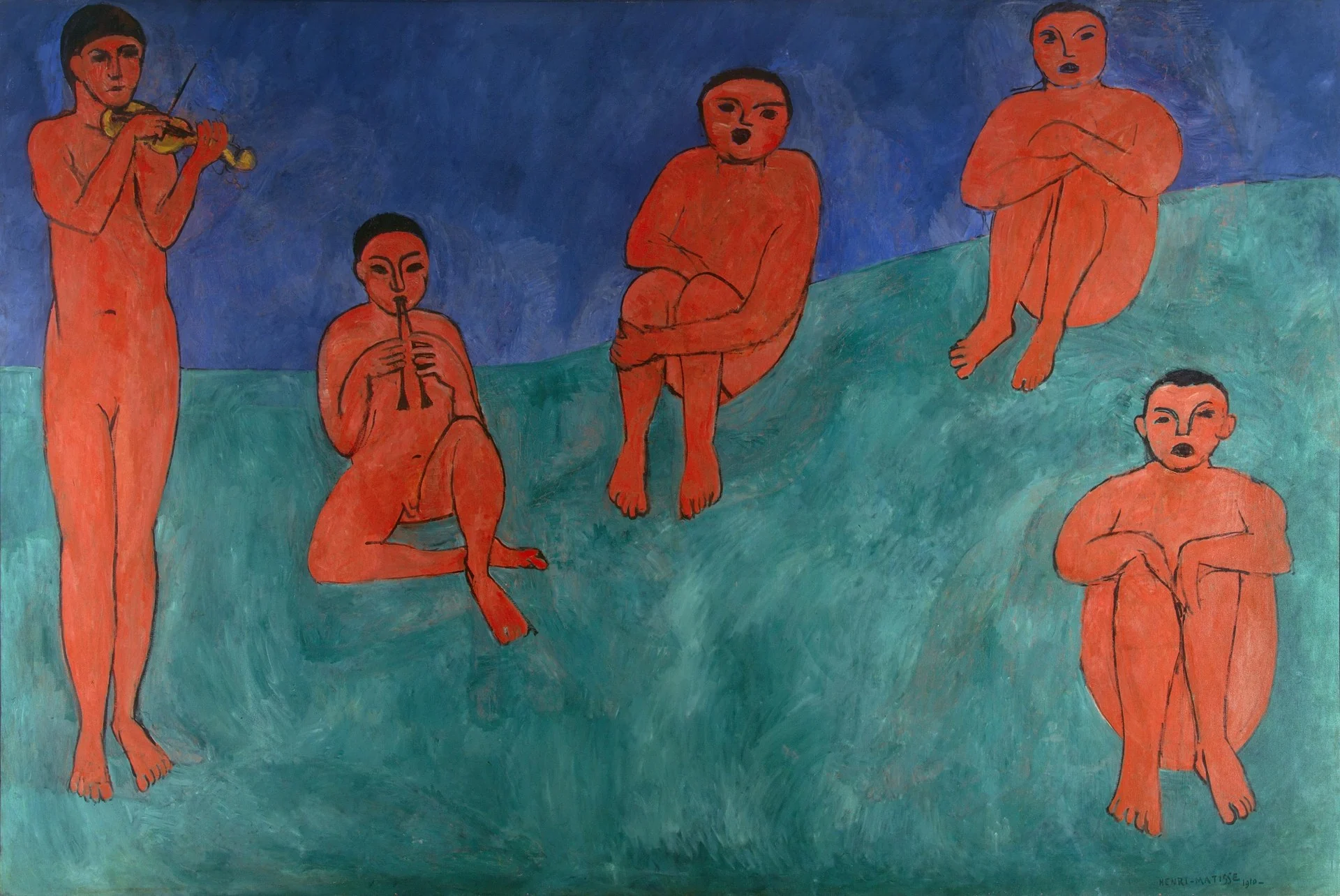
It was made on a commission from Sergei Shchukin1 for his Moscow house, together with “Music”. The scale of the canvas alone makes the figures read not as a small scene but as a space the viewer enters.
If you mentally repair the break between the hands and make the circle perfectly even, “Dance” loses part of its tension. That is a good exercise on the role of imperfection in composition: sometimes a small shortfall keeps the movement going, whereas geometric correctness closes it off.
The fewer the elements, the more visible the weight of each
“Dance” looks like a painting you can understand in a second: five red figures hold hands and move in a circle. There is no complicated space in it, no costume, no faces with individual histories. That clarity is deceptive. The fewer the elements, the more strongly the weight of each decision shows. Shift one arm, change the distance between bodies, raise the green band a little, and the whole system starts breathing differently.
The circle here is not finally closed. Between two hands a tense gap remains, and the figures have to reach. That near-touch is exactly what turns an ornament into an event. A fully joined chain would look stable and finished; the break announces effort, the possibility of collapse, the next fraction of movement. The viewer involuntarily completes the contact and therefore takes part in the dance.

The bodies are not described in anatomical detail, yet their weight is felt. Knees bend, torsos lean, feet look for the ground. Matisse removes individual features without turning people into bodiless signs. The red mass of the figures argues with the green earth and the blue space; colour gives the body density where modelling is almost absent. It is a good example of how simplification requires knowledge rather than replacing it.
Matisse builds the image on a few large colours. The red-orange bodies are sharply separated from blue and green. The colour does not describe natural skin and does not model it with fine transitions. It creates an overall rhythm, almost like a large musical chord.
Simplicity turned out to be a result, not a beginning
There are two versions of “Dance”: a preparatory one, lighter, and the final one made for Shchukin with colour at maximum intensity. The comparison shows that the simplicity did not appear instantly. Matisse strengthened the relations, removed the intermediate, made colour and movement more demanding. What looks almost childlike and spontaneous went through a selection. In art the simple is often not a starting point but a result — reached after the author has understood which details the work can lose without losing force.

The main detail is the break in the circle. Two hands in the lower part of the composition do not join confidently; one figure stretches, the other leans towards it. Had the ring been perfectly closed, the movement might have stopped. A small shortfall creates effort and makes the whole round dance carry on.
In the early version of “Dance” the colour is softer and the relations calmer; in the final work the intensity became almost physical. The comparison shows that colour does not merely fill a drawing already found. It changes the speed and the temperature of the composition. A more active red brings the figures closer, the blue field retreats and simultaneously surrounds them, the green arc holds them like a stage. Three large relations do the work of a multitude of details.
The palette distributes roles
A minimal palette creates a strict contract. Every new shade would require a reason and could destroy the monumentality. In photography a similar effect appears when an author limits a scene to a few large colours. But copying the triad is pointless. What matters is seeing the principle: a palette should distribute roles. One colour carries the body or the event, another the space, a third the support. Then hues govern not the decoration but the viewer’s position.
The rhythm of the figures is not uniform. One leans harder, another almost flies, one seems to be lagging, another pulls the chain onward. The repetition of a human body does not turn into a cliché, because every pose continues its neighbour and simultaneously resists it. It resembles a musical phrase in which equal note lengths do not yet make a dance. Accents, delays and accelerations are needed.

A lesson for the group portrait
There is a practical lesson here for the group portrait. Five people carrying out the same instruction quickly become a set of copies. It is far more alive to distribute a common action across phases: one has already turned, the second is only beginning, the third holds the centre, the fourth reacts, the fifth closes the movement. The viewer reads not five poses but one process. Even a static frame acquires time.
The poses are not an anatomical atlas either. Matisse simplifies bodies into directions and weights. One figure leans back, another almost falls forward, the steps differ. We do not examine each person — we feel a general transmission of movement.

That is exactly why the painting’s simplicity is deceptive. Removing detail is easy; leaving only the necessary relations afterwards is hard. Here every line answers for the rhythm and every colour occupies an enormous emotional area.
“Dance” can be received as joy, as a primal ritual, as unity, or as a tense attempt not to break the circle. The painting does not explain which feeling to choose. It first makes the viewer’s body feel the movement, and the meaning comes later.
The emptiness around the bodies is not leftover canvas
The background of the painting is extremely simple but not empty. The green arc sets the tilt of the ground, the blue surround increases the scale. Remove that boundary and leave the figures on a flat plane, and the sense that the circle is holding on at the edge of the world disappears. The simplicity works because every field is exactly placed. The emptiness around the bodies is not leftover unpainted canvas; it gives the movement space and strengthens their vulnerable connection.
Matisse offers the viewer no precise point of observation. We are not standing on a real site and cannot measure the perspective2. Space is subordinated to the dance. That frees the body from an everyday scene and makes the action almost primary: people exist because they are moving together. For a contemporary image such a refusal of detailed context can be strong if the subject really is universal. But it can also erase specificity and turn the subjects into symbols. You have to understand the price of generalisation.

Faces are almost absent, so emotion is conveyed through the torso and the distance. That is a useful reminder for a photographer who relies too heavily on the expression of the eyes. A small figure in a frame can stay emotionally exact if the lean, the step, the direction of the arms and the gap between figures read clearly. Sometimes a wide shot tells the truth about relations more honestly than a close-up, because it shows who is pulling, who is lagging and where the chain might break.
Refusing an individual accent
The red bodies are perceived at once as separate people and as a single sign. The contour ties them to the background, the arms to each other, the repetition of colour into a common system. That double mode holds attention: we see the composition whole and go on moving from figure to figure. Had one of them been a different colour, it would instantly have become the protagonist and changed the meaning. Matisse gives up an individual accent for the sake of a common movement.
There is a political and a human ambiguity in this. A circle can mean community, liberation, ritual, and it also requires every body to take part in a common tempo. The break between the hands makes the connection voluntary and fragile rather than mechanical. The painting does not hand over a plot that would finally explain the relations. It gives the viewer a bodily situation: hold the others and do not fall out yourself.

Another test is to remove the colour. In a black-and-white version the circle, the breaks, the leans and the distribution of weight remain. The painting does not collapse, but it loses a large part of its physical force. That proves that colour here is not decorative and does not replace composition: both layers are autonomous and work together. A good colour photograph should also survive a tonal test3, but it is under no obligation to be equally good without colour. Sometimes it is precisely a hue that carries the main meaning.
Minimalism does not save effort
Matisse’s simplification often looks easy only after it has been found. An attempt to remove details quickly reveals that each of them was covering an unsolved problem. The less remains, the more exact the edge, the gap, the repetition and the scale have to be. So minimalism does not always save effort. It transfers effort from the number of elements to the quality of the relations.
“Dance” holds the viewer without a mysterious subject and without complex symbolism. We understand almost everything we see and go on feeling the incompleteness of the movement. The painting does not ask us to decipher objects; it makes our own gaze sustain the circle. That is its practical strength: attention can be held not by a secret but by a rhythm that is about to break and therefore starts up again inside us.
That is a good lesson for any image. Complexity is not measured in the number of details. Sometimes a work becomes stronger when the author removes everything that could have covered up an inexact rhythm.
Notes
- 1A Moscow textile manufacturer who assembled, before the revolution, the largest collection of new French painting in the world — more than fifty Picassos and Matisses, bought at a time when almost nobody in Paris would take them. “Dance” and “Music” were commissioned for the staircase of his mansion in Bolshoy Znamensky Lane; today both works are in the Hermitage. ↑
- 2A system for constructing depth in which objects shrink with distance and lines converge on a vanishing point. Matisse does not use it here at all: it is impossible to measure the distance between the figures or to the horizon, and space obeys the dance rather than the other way round. ↑
- 3Converting an image to black and white for a single purpose — to see whether the composition holds on relations of light and dark. If the frame falls apart without colour, colour was doing the work of construction; if it survives, both layers are autonomous. ↑