
JournalArt9 min

Sixteenth-century Venice already knew what large-scale painting was supposed to look like. There was Titian with his colour, there were Michelangelo’s powerful figures, there were rules of prestige and workshops with queues of clients. Tintoretto entered that system as though no quiet place in it had been set aside for him.
His real name was Jacopo Robusti, and the nickname comes from his father’s trade as a dyer: tintore is Italian for a dyer. Legend has it that the young painter studied briefly with Titian, though the details of the story are disputed. His artistic ambition, on the other hand, was formulated quite clearly: to join Michelangelo’s drawing to Titian’s colour.
To build complicated foreshortenings Tintoretto is said to have used small wax figures and models of a space, lighting them like a stage. Even if some details of the legend are embellished, the method fits the result well: his pictures look not like a flat arrangement of characters but like an environment directed in advance. That makes him a relative of the photographer who checks the light and the blocking on a mock-up first and introduces the people afterwards. Apparent spontaneity often rests on very practical preparation.

The union turned out not to be academic. Tintoretto built deep diagonal spaces, threw figures into sharp foreshortening, snatched them out with light. His scene rarely arranges itself calmly in front of the viewer. It begins before the edge of the picture and continues beyond it.
This is especially visible in religious subjects. Where another painter would put the main event in the centre, Tintoretto could move it into the depth, fill the foreground with movement and make the viewer half lose themselves at first. That is not a compositional error but a way of living through an event as a participant rather than as an attendee at a lecture.

To contemporaries that speed looked like genius one moment and carelessness the next. The works really do carry the sense of a man who wants to do more, and faster, than careful finishing allows. But that is exactly what gives the pictures a tension unexpectedly close to modern staged photography or cinema.
His light does not merely model volume either. It appears inside the action: a flash, a shaft, a patch that leads through the chaos. The viewer is not given an evenly lit world — they have to look for the essential.

In staged photography a similar effect comes from displacing the main event. Put the subject not in the habitual centre but in the depth, and lead to them with light and with movement in the foreground, and the viewer enters the environment first. It is harder, but the scene feels as though it happened rather than having been set out in front of a camera.
Tintoretto wanted to take the best from two giants, and became strong where he stopped being their sum. Other people’s influence passed through his temperament, his working rhythm and a personal need for movement.
Venice: talent alone was not enough
The nickname Tintoretto translates conveniently as “the little dyer”, but behind the charming sound stands a far from charming temperament. He worked in a city where large commissions were distributed inside a complicated system of confraternities, churches, workshops and patrons. To take a place beside the recognised masters, talent alone was not enough. It took speed, strategy and a readiness to walk through the door while everyone else was still discussing propriety.
The legend of a brief apprenticeship with Titian suits both parties beautifully: it gives one the image of a rejected, insolent pupil and the other that of an imperious master. Documentary detail is scarce, so it is wiser not to construct a psychological serial. The outcome is what matters: Tintoretto really did see two summits in Michelangelo’s drawing and Titian’s colour, and he did not become a tidy intermediary between them. His own speed deformed the formula.
Wax models destroy the myth of pure inspiration
The wax-figure mock-ups are particularly interesting because they destroy the myth of pure inspiration. To make a picture look like a sudden flash, the painter could build a small stage in advance and check the shadows and the turns of bodies. A modern director would make a storyboard, a photographer a lighting test, a 3D artist a previz. Preparation does not kill spontaneity. It creates the space in which a risk can be aimed.
In “The Miracle of the Slave” the figures do not line up in front of the viewer for a convenient introduction. Bodies contract in perspective, the crowd opens out, the saint bursts in from above, gestures fly off along diagonals. First we feel the event, then we work out who is doing what. For academic clarity that is almost a breach of order. For emotional presence it is an exact calculation: a miracle is under no obligation to wait until the viewer has taken a good seat.

“The Last Supper” in San Giorgio Maggiore changes the familiar scheme more radically still. The table runs off on a diagonal, the main event is displaced, domestic figures and objects occupy the space, and a supernatural light breaks through a real room. The viewer seems to have come in from the side, and not at the beginning of the ceremony. Such a viewpoint turns a well-known subject from an emblem into an incident.

Light chooses what counts as reality
Tintoretto’s light does more than explain volume. It chooses what to count as reality in this second. Some bodies all but dissolve, others flare up; the angelic and the human can exist in different lighting regimes. A camera usually tries to level the scene: bring detail back in the shadows, preserve faces, make the balance comprehensible. But sometimes it is precisely the inequality of light that creates belief in an event. Not everything has to be equally available.
Contemporaries could take the speed of the handling for a lack of finish. It is easy to romanticise carelessness here: the genius, we say, was too fast for the rules. But a large volume of commissions demands organisation, a workshop and a choice about where detail is necessary and where movement is enough. Speed becomes a style only when it preserves meaning. If the form has fallen apart and the viewer does not know where to look, that is not temperament but unfinished work.
The story of the competition for the Scuola Grande di San Rocco1 shows his commercial audacity. Instead of the expected sketch, Tintoretto — so the well-known account goes — installed a finished work in the place intended for it and offered it as a gift. He changed the very situation of assessment: his colleagues were showing a promise, he was showing a result that had already happened, inside the architecture. The move was aggressive and risky; copying it as universal business advice would be strange. But he understood the power of context exactly.

What follows from this for a photographer
For a photographer the lesson is not “work for free”. Something else is more useful: an idea becomes more convincing when the viewer sees it in the environment it was invented for. One finished test, a small mock-up of a series, an example spread can explain an intention better than twenty adjectives. The scale of the demonstration should be limited, and the rights and the further work agreed. Audacity without boundaries turns into unpaid labour very fast.
But the method requires trust in the viewer. Enlarge everything important, light it and put it in the middle, and a mistake becomes impossible — along with anything to experience. Tintoretto permits a brief loss of orientation. We search, stumble over a gesture, notice a flare, assemble the event. Steering attention here is nothing like a signpost. It is the direction of a search, in which a small effort becomes part of the emotional experience.
Influence becomes a style after distortion
His style grew out of the ambition to catch up with two giants, and survived because it coincided with neither. The formula “Michelangelo’s drawing plus Titian’s colour” sounds like a beginner’s mood board. The real Tintoretto appears where speed, theatricality, risk, Venetian light and personal impatience are added to the references. Influence becomes a style not after successful copying but after consistent distortion to fit one’s own character.
The San Rocco story is a retelling, not a transcript
The San Rocco episode should be told exactly as a story that reached us through Vasari’s2 retelling, not as the transcript of a cunning tender. A documentary framework does exist: a competition was announced in 1564, Tintoretto’s work ended up installed on the ceiling, the gift was accepted, and the collaboration stretched over decades. The legendary line makes the plot brighter, and it must not matter more than the result. Otherwise the artist turns into the hero of a business case and an enormous religious cycle into the prize for a clever marketing move.
Tintoretto’s speed had its price too. A large workshop, the participation of assistants, uneven execution and problems of attribution are the other side of astonishing productivity. This is not an exposé of a genius but the normal mechanics of scale. A contemporary author does well to see both halves: a fast temperament can give work energy, but volume inevitably demands a system and control of the key decisions. Otherwise a characteristic gesture starts repeating not as a style but as a production habit. Scale strengthens an author’s language only for as long as the author can tell where repetition supports the intention and where it merely saves effort.
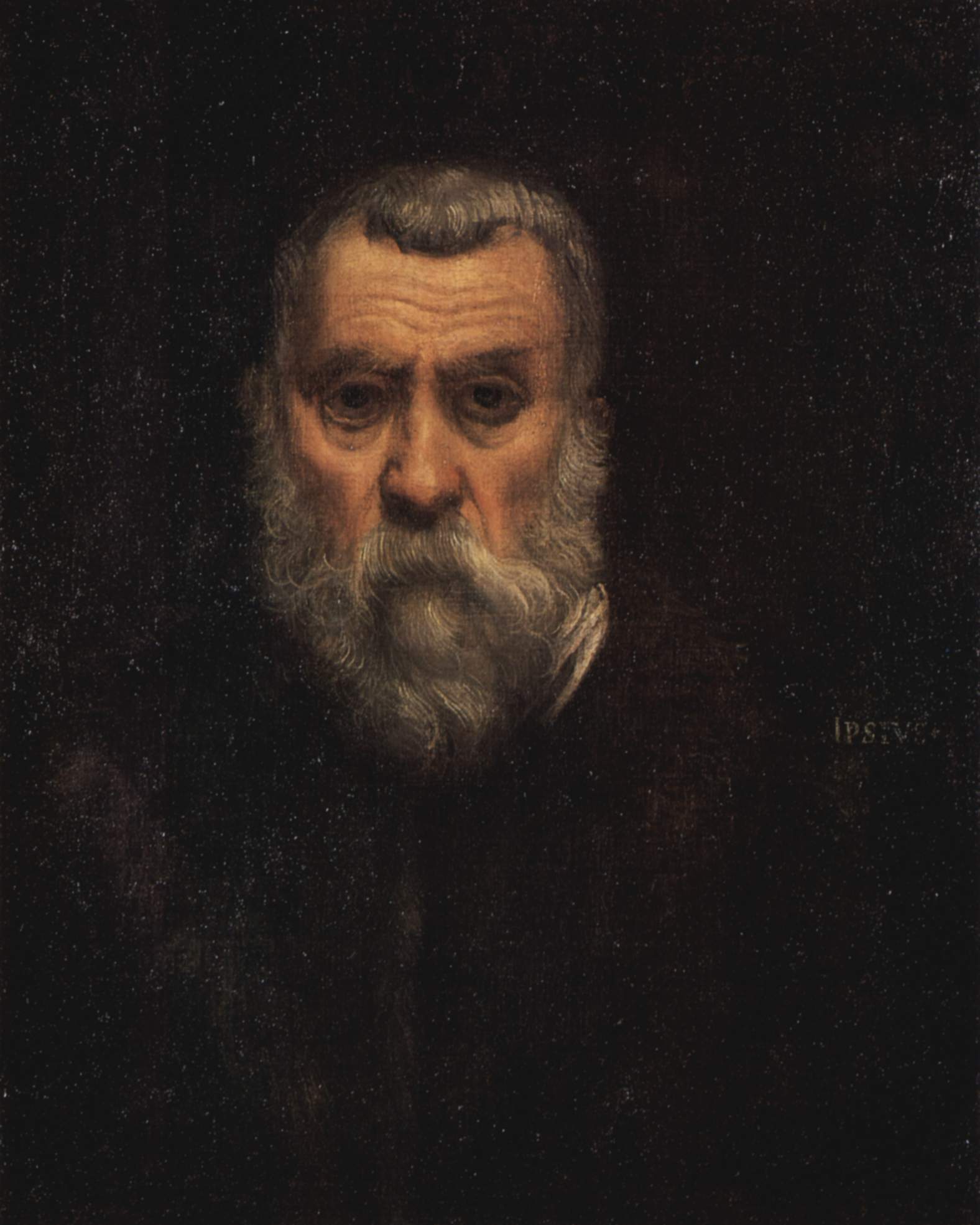
Sometimes a style arises not from a calm choice of devices. It appears because the author breaks the rules again and again in the same way — a way that belongs only to them.
Notes
- 1The scuole were Venetian lay confraternities, something between a guild, an insurance fund and a parish. The wealthiest of them built their own premises and commissioned cycles of paintings: the client was neither the church nor a court but an association of townspeople. ↑
- 2Giorgio Vasari, author of the “Lives”, the first collection of artists’ biographies. He wrote in Florence, knew the Venetians less well and retold anecdotes readily; checking him against documents is almost always necessary. ↑