
JournalArt10 min

Titian was not an artist discovered after his death. He became the leading painter of Venice in his own lifetime, painted emperors, kings and popes, received large commissions and watched others take up his manner. That is a rare opportunity — to live long enough for your own success to become the past.
He began in a Venetian milieu where colour carried particular weight. The young Titian was strongly influenced by Giorgione1; the authorship of some early works is still debated, and the completion of certain pieces after Giorgione’s death is a matter of cautious attribution rather than a simple inventory of an estate. Gradually Titian emerged from the shared manner and took the position of the city’s first painter.
His early pictures are easy to recognise by their clear physicality and rich, gathered colour. People exist in them as more than diagrams of character: even in a large mythological or religious subject a face is granted psychological separateness. That is exactly why Titian became such a powerful portraitist of power.

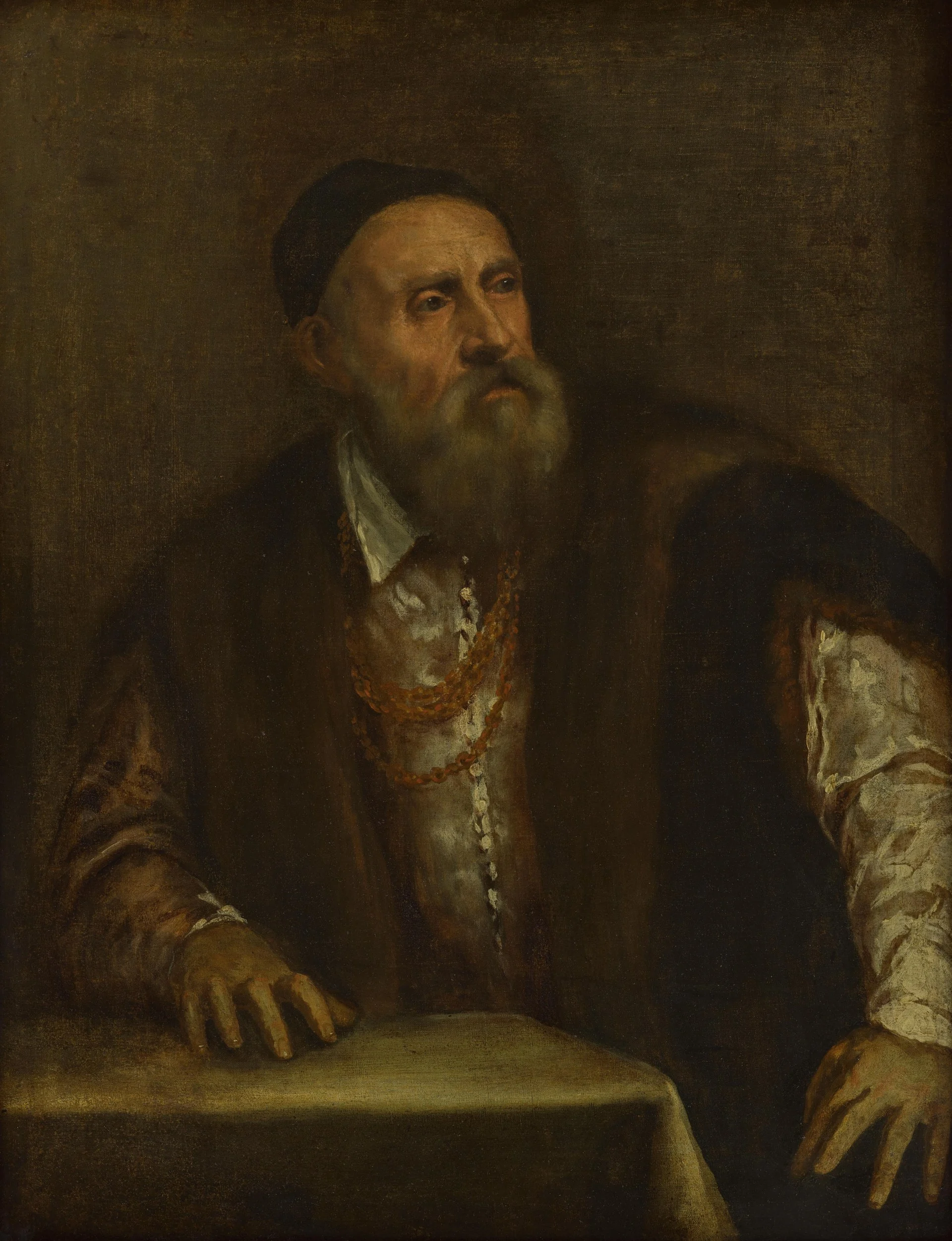
Titian’s portraits show particularly well how an artist worked with power. Rich fabric, fur, weapons and a dark background create status, but the character does not dissolve into symbols. The gaze can be tired, wary, cold; a hand sometimes says more about a person than the regalia. The client wanted an image of position; the artist added the sense of an inner life. So a state portrait by Titian does not reduce to an antique version of corporate photography — it serves power and examines the person who holds it at the same time.
But the late works are more interesting to look at. With age the handling becomes freer. The brushstroke no longer hides, contours dissolve in places, form seems to assemble only at a distance. A contemporary used to smooth finish might have seen carelessness in it. We see an artist who has stopped proving his control with every detail.

This change does not look like a loss of skill. Rather, skill has reached the point where the author knows which part need not be explained. Paint begins to convey not only the surface of cloth or skin but the air itself, the instability of sight, the movement of time.
Titian lived a long life and probably died during an outbreak of plague2. Over those decades the patrons, the politics and the artistic tastes changed, while his name had already become a measure of quality. He could have repeated the formula he had found; instead the late painting went on taking risks.
Success creates a formula that has proved itself too well
Your own success is dangerous not because it spoils the character. It creates a working formula that has proved itself too well. Clients ask for exactly that, apprentices repeat it, the public recognises it from across the room. The author acquires a rare privilege — no longer having to explain who they are. And at the same time a risk appears: to stop recognising yourself in what everyone else recognises unerringly.
The Venetian school3 gave Titian a particular relation to colour. In Florence the theorists could emphasise drawing and construction; in Venice colour was understood as a way of assembling form through light, air and matter. This was not, of course, a simple war between two camps, but the difference matters. In Titian a red cloak is not a coloured surface laid over a drawing. It has weight, it glows, it sets the status and the temperature of the whole scene.

The early proximity to Giorgione shows that an individual style does not arrive ready-made at birth. The young works could be so close that authorship is still under discussion. Titian grew through a shared language, borrowings, competition and the completion of other people’s projects. His uniqueness arose not from an absence of influences but from a long process of selection: which possibilities of the common manner suited his temperament.
The portrait of power: symbols visible, the person not erased
In portraits of power he found a balance photographers still use. The symbols of status have to be visible without replacing the person. Fabric, fur, weapons, a column or a chair report the position. The face and the hands report the price of that position: fatigue, caution, the habit of giving orders, the necessity of holding oneself together. When both lines exist at once, the state image stops being advertising and becomes observation.
The equestrian portrait of Charles V builds power literally: the rider, the armour, the forest, the weapon, the forward movement. And yet the image does not turn into a noisy poster. The colour is gathered, the figure separated, the gaze concentrated. The viewer is given not so much an account of a particular battle as the sense of a person carrying a historical role. Photographing a chief executive today solves the same problem in a different costume: how to show scale without drowning the face in the attributes of success.

The late technique is the visibility of process
Titian’s late technique feels especially modern because the process is visible. Up close the strokes can look crude, the paint smeared, the contour unfinished. But from a distance the material assembles into skin, cloth, air. The artist stops covering the traces of work and invites the viewer to complete the image with their own sight. That is trust not only in one’s mastery but in the person looking.
Freedom here is not the same as carelessness. To leave a form unsaid you have to know exactly which information is necessary. Accidental blurring guarantees nothing; an accidental stroke stays accidental. A late master economises not on labour but on explanation. He can remove a detail because the colour relation, the direction of movement and the light already hold the whole together. A beginner often removes it before the whole has appeared.
The same temptation in the edit
Photographic post-processing meets a similar temptation. First we learn to control everything: clean the skin, even out the tone, recover detail, suppress noise, make the sharpening convincing. Then the image starts to suffocate under proofs of quality. At some point professional growth consists not in a new way of increasing control but in the ability to leave a shadow dark, skin alive, movement slightly blurred — if that conveys presence more precisely.
Titian’s late works change the emotional distance too. Early beauty often presents the body confidently and clearly. The late surface seems to know about decay. Form appears and disappears; light does not so much illuminate matter as hold it briefly in place. This is no longer merely virtuoso painting about a subject; the paint itself begins to speak of ageing, of memory, of the impossibility of fixing what has been seen once and for all.

A long career also means a constantly changing audience. What was innovation in youth becomes official taste a few decades later. An artist hears his own language in the works of pupils and imitators. Repeating yourself is easier than arguing with your own school. Titian is interesting because his late manner does not look like a cosmetic refresh of a brand. It changes the contract with the viewer: less smooth demonstration, more participation and uncertainty.
For any author it is useful now and then to separate what they genuinely want to continue from what the people around them have learned to buy. This is not a call to burn your portfolio. A successful formula brings money, trust and the possibility of working. But inside it you can keep a laboratory — a small series with no obligation to please, a new light, an unfamiliar tempo, a material where the outcome is not guaranteed. Otherwise mastery imperceptibly turns into the servicing of one’s own reputation.
Surviving success means not renouncing what you found but ceasing to consider it the last word. Titian did not cross out the colour, the physicality and the psychology of his early works. He brought them to a state where they could exist without a smooth surface. That is grown-up freedom: not proving that you can still do everything as before, but hearing which solution has become the more honest one now.
The late Titian is not an early Impressionist
It matters not to turn the late Titian into a convenient forerunner of Impressionism. That free surface has not reached us unchanged: pigments age, certain blues may have faded, varnish and old restorations altered the relations between tones, and the degree of finish of some canvases remains disputed. We see the master’s daring, and we see it through the history of the material. That makes the conversation more interesting: the late style is not a striking “old Titian” filter but a complex decision that cannot be reduced to a large brush and blurred edges.
The workshop, the assistants and the question of delegation
Success allowed Titian to run a large workshop and work for international patrons, which means that more than one solitary hand existed under his name. Assistants, repetitions of compositions, different degrees of the master’s involvement are the ordinary part of such production. A contemporary author will easily recognise their own problem of growth here: how to expand a practice without losing the thing people came to you for. Sometimes surviving success means not doing everything personally but understanding which decisions genuinely cannot be delegated.

There is one more risk of late success: the public starts reading any change as a symptom of age. Free brushwork can be taken for a weakening hand, a dark palette for decline, unfinishedness for a lack of strength. But biography must not stand in for sight. First it is worth looking at what the painting is actually doing: how the form assembles, where the light arises, how consistent the decision is. Only then should we ask what part age played. Otherwise we decide in advance what we have seen before we have had time to see it.
There is a useful lesson in this for any author. First we learn to do things correctly: assemble the form, control the colour, finish the surface. With luck, another task then appears — to work out which control can be given up without losing precision. The freedom of the late Titian grew not instead of craft but after it.
Notes
- 1Giorgio da Castelfranco, who died around 1510 at roughly thirty-three. Fewer than a dozen works are indisputably his — hence the perennial arguments about the authorship of pieces close to the early Titian. ↑
- 2The Venetian epidemic of 1575–1577 carried off about a third of the city’s population. Titian died in 1576; the sources name plague as the cause, though there is no direct proof in his particular case. ↑
- 3The argument over the primacy of drawing and colour — disegno against colorito — ran between Florence and Venice throughout the sixteenth century. It was not a war between two camps but a difference of schooling: where form is built by contour, and where it is assembled by light. ↑